

PSLV-C60 successfully launched the SPADEX (Space Docking Experiment) satellites into a planned 474 km circular orbit on December 30, 2024. The two-spacecrafts docked successfully in space on January 16, 2025.
This mission demonstrated key homegrown technologies for India’s Space Vision 2047, including custom mission plans and operations, sensors, control algorithms, docking and undocking, power transfer between satellites, and circumnavigation – all tested in orbit.
Later, after ground simulations and in-space trials based on the first docking, undocking, and circumnavigation, the SPADEX platform and spacecraft docked again on April 20, 2025. The spacecraft then switched to combined control mode, and power transfer between them was tested and completed successfully on April 21, 2025.
CROPS: A Leap in Space Biological Experiments
CROPS stands for Compact Research Module for Orbital Plant Studies. It is an unmanned experimental module that helps ISRO build skills for growing and maintaining plants in space. The first mission, CROPS-1, aimed to show seed germination and plant growth up to the two-leaf stage in orbit. CROPS-1 flew as a payload on the POEM-4 platform during the PSLV-C60 mission, testing seed germination and plant survival for 5 to 7 days. Cowpea (scientific name: Vigna unguiculata) was selected after ground tests on various seeds, thanks to its quick germination time. After launch and separation of the main satellite, the POEM platform dropped to a 350 km orbit, and the CROPS-1 payload was activated. All systems worked normally, with temperature controlled precisely between 20 and 30 degrees Celsius. About 90 minutes later, ground controllers opened an electric valve to add water to the soil. Data from later orbits showed rising carbon dioxide levels, signalling seed germination. On the fourth day, seeds began sprouting from their enclosed tissue strips. By the fifth day, two leaves appeared on the sprouts, fully meeting the mission goals.
National Meet on Aditya L1 Data Release and Payload Performance Appraisal
On January 6, 2025, ISRO shared the first batch of scientific data from Aditya-L1 -India’s pioneering solar observatory – with scientists worldwide at ISRO Headquarters in Bengaluru. This date marked the one-year anniversary of Aditya-L1 entering its halo orbit around the Sun-Earth system’s first Lagrange point (L1). The national meeting brought together 40 scientists, academicians, and students from 15 Indian universities and research centers.
The initial datasets included observations from all seven of the mission’s remote-sensing and on-site experiments. The event was followed by a review of the spacecraft’s instruments performance. ISRO then released a second batch of data on February 14, 2025. These datasets provided key insights into the Sun’s surface (photosphere), lower atmosphere (chromosphere), and outer atmosphere (corona), along with direct measurements of particles and magnetic fields at L1.
Cabinet approves the establishment of Third Launch Pad
The Union Cabinet approved the establishment of the Third Launch Pad (TLP) at Satish Dhawan Space Centre of ISRO at Sriharikota, Andhra Pradesh.
The Third Launch Pad project envisages the establishment of the launch infrastructure at Sriharikota, Andhra Pradesh for the Next Generation Launch Vehicles of ISRO and also to support as standby launchpad for the Second Launch Pad at Sriharikota. This will also enhance the launch capacity for future Indian human spaceflight missions.
100th Launch from the India s Spaceport, Sriharikota: GSLV-F15/NVS-02
On January 29, 2025, ISRO marked its 100th launch from the Sriharikota spaceport with the 17th flight of the GSLV rocket. The mission successfully placed the NVS-02 navigation satellite into the planned Geosynchronous Transfer Orbit. All rocket stages worked perfectly, and the orbit was reached with high accuracy. However, orbit-raising steps to move the satellite to its final position could not happen because the valves for feeding oxidizer to the thrusters did not open. The satellite’s systems are healthy, and it is now in an elliptical orbit.
1000 orbits completed for PSLV Orbital Experimental Module (POEM-4)The PSLV’s fourth stage (PS4) served as the PSLV Orbital Experimental Module (POEM-4) and carried 24 payloads -10 from non-governmental entities and 14 from ISRO. All payloads, including those from non-governmental groups, completed their planned experiments successfully in orbit. POEM-4 finished 1,000 orbits on March 4, 2025. It tested experiments in space robotics, seed germination and bacteria growth in microgravity, green propulsion, laser ignition of thrusters, amateur radio signals, and advanced sensors. A space startup also uploaded and ran an AI model as part of an in-orbit AI lab. POEM-4 held the record for the most payloads of any mission so far, surpassing the previous three POEM flights, and once again showed its value as a low-cost, flexible platform for varied experiments.
ISRO develops the first Make-In-India 32-bit Microprocessors for space applications jointly with SCL, Chandigarh
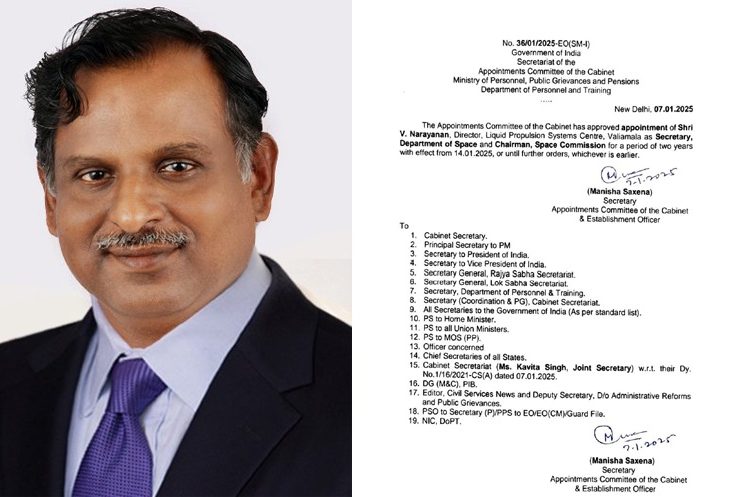
On March 5, 2025, the first batches of two 32-bit microprocessors for space use VIKRAM3201 and KALPANA3201 – were handed over to Dr. V. Narayanan, Secretary, DOS /Chairman, ISRO by Shri S. Krishnan, Secretary, MeitY at an event in New Delhi, organized by the Semiconductor Laboratory (SCL) in Chandigarh. These microprocessors were designed and developed by ISRO’s Vikram Sarabhai Space Centre in partnership with SCL.
VIKRAM3201 is the first fully Make-in-India 32-bit microprocessor that is qualified for use in the harsh environmental conditions of launch vehicles. It was produced at SCL’s 180nm CMOS semiconductor plant and is an improved version of the 16-bit VIKRAM1601, which has powered ISRO’s launch vehicle systems since 2009.
KALPANA3201 is a 32-bit SPARC V8 RISC microprocessor based on the IEEE 1754 Instruction Set Architecture. It supports open-source software tools, along with custom simulators and development environments, and has been tested with real flight software
Inauguration of Centre of Excellence at IIT Madras
Chairman, ISRO / Secretary, DoS inaugurated ‘Centre of Excellence (CoE) for Research in Fluid and Thermal Sciences’ at IIT-Madras on March 17, 2025. The centre is named as S Ramakrishnan Centre of Excellence, in honour of renowned space scientist (late) Dr. S Ramakrishnan, Former Director, LPSC and VSSC, ISRO. Notably, he was also an alumnus of IIT Madras.
A Memorandum of Understanding (MoU) was signed on November 11, 2024, between ISRO and IIT Madras towards establishment of the CoE in the area of Fluid and Thermal Sciences. The CoE will be leveraged for solving thermal and fluid related problems regarding the design, analysis and testing of various fluid-thermal components of ISRO s spacecrafts and launch vehicles.
1000 Hours Firing Life Test of Stationary Plasma Thruster (SPT) for Electric Propulsion System (EPS)
On March 27, 2025, ISRO successfully completed the life test of 1000hrs on the 300mN Stationary Plasma Thruster, that is developed for induction into the Electric Propulsion System of satellites. The Electric Propulsion System is proposed to replace the chemical propulsion system in future satellites of ISRO and pave the way for communication satellites which use only electric propulsion systems for orbit raising and station keeping.
ISRO satellites forecast wheat production
ISRO in a study using remote sensing satellites has estimated that the total wheat production from eight major wheat growing States of India would be 122.724 million tonnes as on March 31, 2025.
CROP (Comprehensive Remote Sensing Observation on Crop Progress), a semi-automated, scalable framework is developed by NRSC/ISRO which enables the near real-time monitoring of crop sowing and harvesting during the Rabi season across India. Using this approach, the progress of Wheat sown areas and the overall crop condition across Indian states were systematically assessed, using Optical and Synthetic Aperture Radar (SAR) remote sensing datasets from EOS-04 (RISAT-1A), EOS-06 (Oceansat-3), and Resourcesat-2A, for the Rabi season, 2024-25.
The wheat sown area derived from satellite data by March 31, 2025 stands at 330.8 lakh hectares, which is close to the statistics generated by the Ministry of Agriculture and Farmers Welfare (324.38 lakh hectares) as on February 4, 2025.
Experimental assessment of wheat production, at the national scale, is done by assimilating satellite-derived parameters such as crop area, sowing date information, and in-season crop condition in a process-based crop growth simulation model at 5km 5km spatial resolution.
North East Students’ Programme for Awareness, Reach, and Knowledge on Space (NE-SPARKS) Program
The North East Students’ Programme for Awareness, Reach, and Knowledge on Space (NE-SPARKS) is a pioneering initiative aimed at igniting curiosity and fostering awareness about space science and technology among students from the North Eastern Region (NER) of India. This program seeks to bridge geographical and informational gaps by providing students with an immersive experience of India’s advancements in space research and exploration through visits to ISRO Centres in Bengaluru.
The program is being executed in eight batches with a minimum one-month interval starting from April-2025 to December-2025. Till date, around 700 students in 7 batches have been provided the opportunity to witness cutting-edge technologies, interact with eminent scientists and engineers through a carefully designed guided tour. Students gained insights into ISRO s mission to explore the unknown, enabling them to envision a future in Science, Technology, Engineering, and Mathematics (STEM). Students had the opportunity to visit the Satellite Control Centre (SCC), Mission Operations Complex (MOX), and the Indian Deep Space Network (IDSN) at Byalalu, gaining first hand insight into satellite operations and deep space communications. They also visited UR Rao Satellite Centre (URSC), exploring spacecraft integration facilities and the URSC exhibition area. They had also visited the Jawaharlal Nehru Planetarium with an engaging lecture and planetarium show on Gaganyaan.
India Hosts GLEX 2025: Forging Global Pathways in Space Exploration
The Global Space Exploration Conference (GLEX) 2025 was held between May 7-9 in New Delhi and it marked a milestone in international collaboration. It was co-hosted by ISRO and the Astronautical Society of India (ASI) under the International Astronautical Federation (IAF). The high-profile summit, themed Reaching New Worlds: A Space Exploration Renaissance, drew leaders, astronauts, and scientists from over 35 countries, reinforcing India s central role in international space diplomacy and innovation. GLEX 2025 featured more than 240 interactive presentations across 10 technical sessions and 15 thematic areas, showcasing global advances in space exploration.
PSLV-C61 / EOS-09 Mission
The PSLV-C61 mission, ISRO’s 101st launch endeavour, aimed to deploy the 1,696 kg EOS-09 Earth Observation Satellite into a 505 km Sun-Synchronous Polar Orbit, enhancing India’s all-weather radar imaging for agriculture, disaster management, and surveillance. PSLV-C61 marked the 63rd flight of the Polar Satellite Launch Vehicle and the 27th using the PSLV-XL configuration.
On 18th May 2025, launch was attempted and PSLV-C61 performance was normal till 2nd stage. Due to an observation in 3rd stage, the mission could not be accomplished.
Successful third Hot Test of Semi-Cryogenic Engine Power Head Test Article
ISRO commenced a series of performance evaluation tests in March 2025 of the Semicryogenic engine Power Head Test Article (PHTA) that comprises all the engine systems except the thrust chamber. These tests were planned to validate the design of the propellant feed system, including the low-pressure and high-pressure turbo-pumps, the pre-burner, start system and control components. On May 28, 2025, the Power Head Test Article (PHTA) underwent a third hot test at the ISRO Propulsion Complex (IPRC), Mahendragiri, that was aimed at validating the engine s ignition and start-up sequence and to derive optimum sequence for the integrated engine. During the test, the engine was successfully ignited and operated up to 60% of its rated power level, demonstrating stable and controlled performance throughout the firing. The PHTA has earlier undergone two hot tests. The first test on 28.03.2025, demonstrated the smooth ignition & bootstrap operation over a short duration of 2.5 seconds. The second hot test on 24.04.2025, demonstrated the start transient build up and tested the start-up sequence by carrying out a hot-firing for a duration of 3.5 seconds. The third test, conducted today, was carried out for a duration of 3 seconds to further fine-tune & finalize the start-up sequence.
The Semi-Cryogenic Propulsion Stage (SC120), powered by the 2000 kN-class SE2000 engine, is being developed to replace the current liquid core stage (L110) of the LVM3 launch vehicle towards enhancing its payload capability.
ISRO Academia Connect Workshop at Space Technology Incubation Centre (STIC) Facility MANIT, Bhopal
Indian Space Research Organisation (ISRO) has organised one-day Academia Connect workshop for Central region (Madhya Pradesh, Uttar Pradesh and Chhattisgarh) at MANIT Bhopal on May 22, 2025. Dr. V. Narayanan, Secretary, DOS / Chairman, ISRO inaugurated the workshop in the presence of Dr. K. K. Shukla, Director, MANIT Bhopal and Shri M. Ganesh Pillai, Scientific Secretary, ISRO.
Senior Scientists from all across ISRO / DoS Centres delivered talks on various potential research areas in Space Science and Technology domain, where academia and ISRO can collaborate. Programme was attended by more than 200 academicians and researchers from 70 Engineering Colleges / Universities across Madhya Pradesh, Uttar Pradesh and Chhattisgarh.
First Indian to ISS: Axiom-04 Mission with Gaganyatri Shubhanshu Shukla successfully completed.
The Axiom-04 mission ended successfully when ISRO astronaut Shubhanshu Shukla returned to Earth. This was a proud moment for ISRO and India after his historic 18-day scientific stay on the International Space Station (ISS). The mission was launched on June 25, 2025, aboard a SpaceX Dragon spacecraft, in partnership with NASA, Axiom Space, the European Space Agency (ESA), and other global teams.
During his stay aboard the ISS, Shubhanshu Shukla adapted exceptionally well to the microgravity environment. Despite the physical and psychological challenges of spaceflight, he maintained optimal health throughout the mission. He captured a wide array of photographs and videos documenting life and work in orbit. He also completed a suite of seven microgravity experiments developed by Indian research institutions under the Human Space Flight Centre s (HSFC) coordination. These experiments explored muscle regeneration, algal growth, crop viability, microbial survivability, cognitive performance in space, and the behaviour of cyanobacteria each aimed at enhancing understanding of human spaceflight and microgravity science.
The mission included strong public outreach to share India’s space success with its people and youth. These activities inspired the next generation and celebrated national pride. On June 28, 2025, Shubhanshu had a live video call from the ISS with Hon ble Prime Minister Narendra Modi. Hon ble PM praised his role in India’s space story and shared the nation’s joy in seeing the Indian flag in orbit. The event reached millions of viewers in India and became a key step in India’s space partnerships. On July 03, 2025, Gaganyatri Shubhanshu Shukla interacted with school students from Trivandrum and Lucknow through a video link, where he answered many questions on how to become an astronaut and life onboard the International Space Station.
ISRO – STC Confluence -2025 at IIT Kharagpur
The Indian Space Research Organisation (ISRO), in association with the Indian Institute of Technology (IIT) Kharagpur, organised a second edition of ISRO STC Confluence on July 1st & 2nd, 2025 at IIT Kharagpur.
Dr. V Narayanan, Chairman, ISRO and Secretary, DoS inaugurated the confluence and released the ISRO – STC Confluence Proceedings in the presence of Scientific Secretary, ISRO and Director, IIT Kharagpur. It is a comprehensive document of compilation of select research projects from the nine Space Technology Cells (STCs) established by ISRO in premier academic institutions across the country. These projects have demonstrated significant technological relevance and have contributed directly to various ISRO missions in domains including spacecraft systems, propulsion, sensors, materials, and AI applications.
Department of Space Conducts Chintan Shivir 2025 for Implementing Space Vision 2047 and Envisioning Beyond
As per the directive of Honorable Prime Minister, Shri Narendra Modi, with the objective of carrying forward the strategies, action plans, milestones etc., for achieving the goals envisioned in Space Vision 2047 as well as to evolve space vision beyond 2047, the Department of Space (DoS) has organized a three-day workshop, “Chintan Shivir 2025,” from July 16th to 18th, 2025. The three-day work shop was conducted with the theme Implementing Space Vision 2047 and Looking Beyond , aligning with the objective of the workshop.
he workshop brought together experts of ISRO, NSIL, IN-SPACe, DoS and other autonomous establishments of DoS to chart a comprehensive roadmap for DoS by revisiting the Space Vision 2047 and to evolve space vision beyond 2047. The experts discussions focused around 11 pivotal domains including space transportation, space infrastructure, space applications, human space exploration, enabling Indian space industries and space business.
NISAR Mission: A Milestone in Indo-US Space Collaboration
NASA-ISRO Synthetic Aperture Radar (NISAR), the first joint satellite of ISRO and NASA was launched by ISRO s GSLV-F16 on July 30, 2025 at 1740 hrs IST from Satish Dhawan Space Centre (SDSC SHAR), Sriharikota.
NISAR, weighing 2392 kg, is a unique earth observation satellite and the first satellite to observe the earth with a dual frequency Synthetic Aperture Radar (NASA s L-band and ISRO s S-band) both using NASA s 12m unfurlable mesh reflector antenna, integrated to ISRO s modified I3K satellite bus. NISAR observes earth with a swath of 242 km and high spatial resolution, using SweepSAR technology for the first time. The satellite scans the entire globe and provide all weather, day & night data at 12-day interval and enable a wide range of applications. NISAR can detect even small changes in the Earth s surface such as ground deformation, ice sheet movement and vegetation dynamics. Further applications include sea ice classification, ship detection, shoreline monitoring, storm characterization, changes in soil moisture, mapping & monitoring of surface water resources and disaster response.
The NISAR launch is the result of strong technical cooperation between ISRO & NASA/JPL technical teams for more than a decade.
ISRO organizes Space Analog Mission in Tso Kar Valley, Ladakh
Indian Human Spaceflight Programme is a national endeavour led by ISRO and aims to extend the human presence across solar system, starting with human spaceflight missions to Low Earth Orbit (LEO) and achieving Indian Crewed Lunar Landing by 2040. This requires undertaking systematic studies to generate necessary Indian subject data for addressing various physiological, psychological and operational challenges associated with human space flight missions. In this regard, ground based analog missions in environment simulating certain aspects of a typical human space mission provide an opportunity to understand the human health and performance risks.
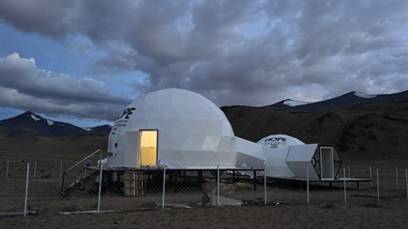
Human Space Flight Centre (HSFC) of ISRO is leading this endeavor for ISRO’s upcoming human space missions. HSFC team led the Ladakh Human Analog Mission (LHAM) in November, 2024 as well as partnered in the recently concluded ten-day Isolation Study ‘Anugami’ involving ISRO’s Gaganyatri in July, 2025. Continuing this endeavor, on 31st July, 2025, Dr V Narayanan, Secretary, Department of Space & Chairman, ISRO inaugurated the Himalayan Outpost for Planetary Exploration (HOPE) analog mission setup in Tso Kar Valley, Ladakh.
Post inauguration, industry partner organised 10-day HOPE analog mission with the shortlisted experiments from partnering national institutions such as IIST & RGCB, Trivandrum; IIT Hyderabad; IIT, Bombay; and the Institute for Aerospace Medicine, Bangalore. Investigators from these institutes examined epigenetic, genomic, physiological and psychological responses of two analog mission crew members and validated health-monitoring protocols, planetary surface operations, and refine sample collection and microbial analysis techniques. The valuable data generated will form the basis for design of protocols and infrastructure for future Indian Human Exploration Missions by providing key insights into technology performance, crew workflows, and environmental adaptation.
HOPE is a specially designed Dia 8 metre Habitat Module for crew living and a Dia 5 metre Utility Module for operations and support systems which are interconnected for seamless workflow. Tso Kar valley was specifically selected for this analog mission due to its striking environmental parallels with early Mars, due to high UV flux, low air pressure, cold extremes and saline permafrost.
Successful static test of KALAM 1200 – solid motor developed by Private startup- at SDSC SHAR, Sriharikota
First Static Test of the KALAM 1200 Motor – the first stage of Vikram-1 Launch Vehicle of M/s Skyroot Aerospace Pvt. Ltd. (SAPL) is accomplished successfully by SDSC SHAR, ISRO on 08-08-2025. This is a major milestone in the configuration and realization of the systems for Vikram 1 Launch Vehicle. The motor is a 11 m long, 1.7 m dia monolithic composite motor with a Propellant Mass of 30t. Based on the design inputs, this longest monolithic motor is prepared at the Solid Propellant Plant, Sriharikota. Similarly, ISRO team has provided the design for the Test Stand, which is used for the static test of the motor.
This is in line with the Government of India initiative on Space Policy, 2023 for providing the necessary technical infrastructure and managerial guidance for the Private Sector players to contribute for the space economic growth. The performance of the test bed and the associated systems is normal as predicted.
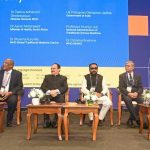
National Meet 2025 (NM 2.0) and National Space Day celebrations 2025 at Bharat Mandapam, New Delhi
On August 24,2025, ISRO accomplished first Integrated Air Drop Test (IADT-01) for Gaganyaan program at Satish Dhawan Space Centre (SDSC), Sriharikota. This test successfully demonstrated the objective of end-to-end performance validation of the critical parachute-based deceleration system of the Crew Module for Gaganyaan mission in one of the typical mission scenarios. This test is part of system level qualification of parachute-based deceleration system, in which a simulated CM, encompassing the deceleration system is dropped using a helicopter.
In Gaganyaan missions, parachute-based Deceleration system is employed during terminal phase of Crew Module (CM) descent to reduce the touchdown velocity of Crew Module to an acceptable limit for safe landing on sea. The parachute system and its layout, for IADT, was same as that of Gaganyaan missions. It comprised of four types of parachutes viz. Apex Cover Separation (ACS) ( 2.5 m – 2 nos), Drogue ( 5.8 m – 2nos), Pilot ( 3.4 m – 3 nos.) and Main parachutes ( 25 m – 3nos.).
Foundation Stone Laid for Launch Pad at SSLV Launch Complex (SLC), Kulasekarapattinam
The SSLV Launch Complex is being established as a dedicated launch complex at Kulasekarapattinam, Tuticorin Dt., Tamil Nadu, in order to meet the growing launch demands of the country, primarily for SSLV launches and for the launch activities of Non-Governmental Enterprises (NGEs). Honourable Prime Minister had earlier laid the foundation stone for the SSLV Launch Complex on February 28, 2024 from Tuticorin. Since then, construction has been progressing for 32 out of the 33 major facilities. On August 27, 2025, Dr. V. Narayanan, Chairman, ISRO / Secretary, Department of Space laid the foundation for the Launch Pad at the SSLV Launch
Complex (SLC). The SLC consists of stage preparation & vehicle integration buildings, launch pad & rail track systems, range systems, checkout systems, telemetry & tele-command systems, safety & firefighting facilities, and general civic amenities. Major systems including the Mobile Launch Structure (MLS), bogies, platforms, doors, Jet Deflection Duct and vibration isolation systems have been designed internally. Major range systems such as radars, telecommand, and telemetry are being developed in-house and being realised through industry partnerships.
Inauguration of MPTTF and ITPF facilities at LPSC/ISRO
The Monopropellant Thruster Test Facility (MPTTF) and Integrated Titanium Alloy Propellant Tank Production Facility (ITPF) were inaugurated on Sept 3, 2025 which are realized by LPSC/ISRO at Tumakuru, Karnataka. MPTTF is designed and established for the qualification, acceptance, and performance evaluation of monopropellant hydrazine thrusters, which are essential for attitude control and orbit maintenance in satellites, spacecraft, and launch vehicles.
ITPF is a state-of-the-art plant which specializes in manufacturing lightweight titanium alloy propellant tanks for spacecraft and PSLV’s PS4 stage, including propellant management devices for microgravity operations. The facility supports advanced processes like electron beam welding, precision machining, non-destructive testing, and cleanroom assembly to meet growing demands for ISRO missions.
Technology Transfer Agreement signed for Small Satellite Launch Vehicle (SSLV)
A technology transfer agreement was signed on September 10, 2025 between NewSpace India Limited, ISRO, IN-SPACe & Hindustan Aeronautics Limited (HAL) for the transfer of the Small Satellite Launch Vehicle (SSLV) technology at ISRO Headquarters, Bangalore.
The SSLV is a three-stage all-solid vehicle designed to launch satellites weighing up to 500 kg into Lower Earth Orbit (LEO). SSLV was developed by ISRO as a quick turnaround, on-demand launch vehicle that is amenable to industrial production and is targeted to cater to the global small satellite launch vehicle market. It can be launched from Sriharikota for inclined launches and also at the upcoming new launch site in Kulasekarapattinam for polar launches.
The SSLV Technology Transfer Agreement is a major milestone enabled by the space-sector reforms announced by the Government of India. The successful commercialization of SSLV is expected to boost the Indian space ecosystem and meet the national and international demand for small satellite launch services.
India Showcases Space Achievements at IAC 2025 in Sydney
The 76th International Astronautical Congress (IAC 2025), hosted in Sydney from September 29 to October 3, highlighted India’s role in global space endeavors. ISRO and IN-SPACe established the India Space Pavilion, which highlighted six decades of India s space odyssey, tracing milestones from pioneering missions like Chandrayaan and Aditya L1 to ambitious future projects such as Gaganyaan and the proposed Bharatiya Antariksh Station. Together, these exhibits reflected India s continuous pursuit of innovation and excellence in space technology.
As part of Indian Space Pavilion, 18 Indian Space industries / Startups have showcased their products & achievements. 5 Indian space industries / startups have established independent exhibition pavilion as part of IAC-2025.
LVM3 launch vehicle has successfully launched the CMS-03 communication satellite
LVM3 launch vehicle has successfully launched the CMS-03 communication satellite in its 5th operational flight (LVM3-M5) on November 02, 2025. CMS-03 is a multi-band communication satellite that provides services over a wide oceanic region including the Indian landmass. CMS-03, weighing about 4400kg, is the heaviest communication satellite ever launched to Geosynchronous Transfer Orbit (GTO) from Indian soil.
Restart of C25 Cryogenic Stage Demonstration in LVM3-M5 Mission
The LVM3-M5 mission successfully achieved the first-ever in-space restart of its indigenously developed C25 cryogenic upper stage, powered by the CE-20 engine. This capability is significant because it allows for greater mission flexibility, enabling future LVM3 flights to deploy satellites into multiple orbits in a single mission. The restart was performed after the primary satellite, CMS-03, was successfully injected into its designated orbit.
PRL/ISRO discovered a new exoplanet
The scientists of the Physical Research Laboratory (PRL), Ahmedabad, have discovered a new exoplanet, TOI-6038A b, a dense sub-Saturn size with a mass of 78.5 Earth masses and a radius of 6.41 Earth radii in a wide binary system. The planet orbits a bright, metal-rich F-type star every 5.83 days in a circular orbit. The TOI-6038A b lies in the transition region between Neptune-like and gas giant exoplanets, called as Sub-Saturn, a category absent in our solar system, providing a unique opportunity to study planetary formation and evolution.
This discovery marks the second exoplanet discovery using the state-of-the-art PARAS-2 spectrograph attached to the 2.5-meter telescope at PRL’s Mount Abu Observatory at Gurushikhar, Mt. Abu. Furthermore, it is the fifth exoplanet detection using the combined efforts of the PARAS-1 and PARAS-2 spectrographs. It highlights India’s growing expertise in advanced astronomical instrumentation, with the PARAS-2 spectrograph being the highest-resolution stabilized radial velocity (RV) spectrograph in Asia.
Memorandum of Understanding on Cooperation in Space Medicine
Indian Space Research Organisation (ISRO), Department of Space (DoS) and Sree Chitra Tirunal Institute for Medical Sciences & Technology (SCTIMST), Department of Science & Technology (DST) signed the Framework Memorandum of Understanding on Cooperation in Space Medicine . This partnership marks significant milestone in the advancement of Space Medicine and its applications in the country.
Indian Human Space program, Gaganyaan is a national endeavour of ISRO offering a unique opportunity to various national agencies, academia and industry in the fields of human health research, microgravity research, space medicine and space biology. This framework MoU between ISRO and SCTIMST will lead to cooperation in the niche field of Space Medicine which will benefit the national human space programme as well as spur innovations and developments in the fields of Human Physiological Studies, Behavioural Health Studies, Biomedical Support Systems, Radiation Biology & Medicine, Countermeasures for improving Human Health & Performance in Space Environment, Telemedicine and communication Protocols and Crew Medical Kit for Space Missions. The program will create opportunities for studies and experiments, especially in the field of Space Medicine.