
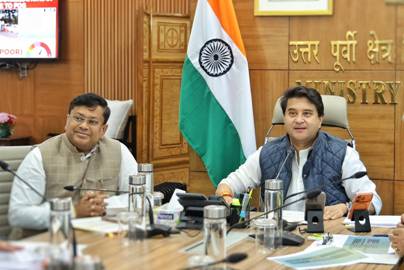

Union Minister for Communications and Development of North Eastern Region, Shri Jyotiraditya M. Scindia, today participated in the meeting of High-Level Task Force on Handlooms and Handicrafts, convened by the Hon’ble Chief Minister of Nagaland, Shri Neiphiu Rio. The meeting saw participation of Dr. Sukanta Majumdar, Hon’ble Union Minister of State of Ministry of Development of North Eastern Region; Smt. Nandita Garlosa, Hon’ble Minister for Sports and youth Welfare, Assam; Sh. F. Rodingliana, Hon’ble Minister of State for Commerce & Industry, Mizoram; Secretary, Ministry of Development of North Eastern Region; and senior officers of Government of Manipur and Ministry of Textiles.
A cluster-based development approach for handlooms and handicrafts was discussed, with the objective of strengthening the entire value chain and ensuring sustainable and remunerative livelihood for artisans. The approach focuses on skill upgradation through master craftsman training; quality testing and certification; promotion of sustainable natural fibres and natural dyes, and integration with e-commerce platforms for domestic and export markets.
Shri Jyotiraditya M. Scindia, emphasised that the Ministry of Textiles should take leadership from a handloom and handicrafts perspective and develop a clear structure, beginning with one handloom and one handicraft product, and demonstrate success. With the focus areas already identified, discussions centred on how to move forward, starting with the identification of artisans within handloom or handicraft clusters.
It was highlighted that the value chain must be developed taking into consideration the market demand and the production chain should be established accordingly, and not the other way around. Product differentiation at the end-product level should also be part of the strategy to promote handlooms and handicrafts and this is possible when markets and buyers are also integrated into the value chain. The need to identify interventions required from all stakeholders, including MDoNER, Ministry of Textiles, State Governments, private parties, to move from the current situation to the desired outcome, was also underscored.
The discussions further emphasised the importance of on-ground handholding, with a proposal to deploy one handloom and handicraft resource person at the cluster level and to have a representative of the buyer present on the ground to ensure alignment with market requirements.
Highlighting the long-term impact of the initiative, Shri Jyotiraditya M. Scindia stated, “By bringing all stakeholders into the value chain, we will be able to see, over the next 2–3 years, how the income of artisans grows. The key question is what impact our interventions will have on the weavers. Our end objective is to ensure that this project brings long term benefit to artisans. Handloom and handicrafts are art forms and India’s wealth. Handmade products are witnessing unprecedented value, comparable to precious stones. India must not only preserve this heritage but make it truly remunerative for its artisans.”