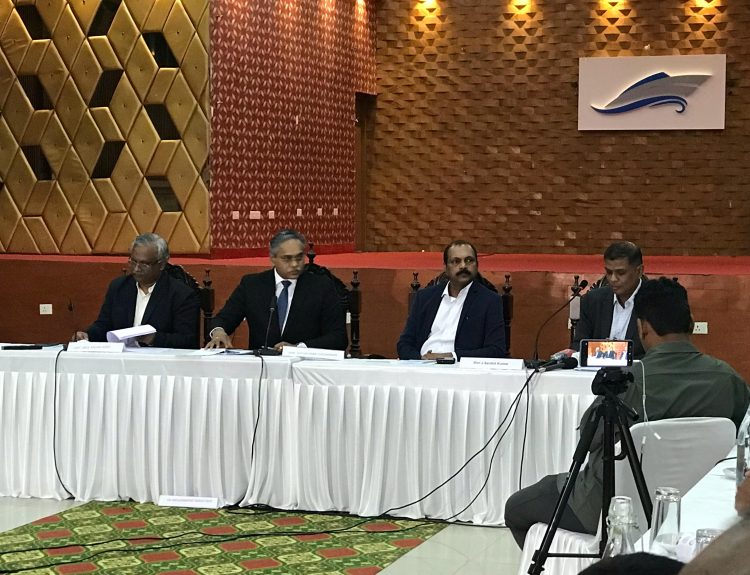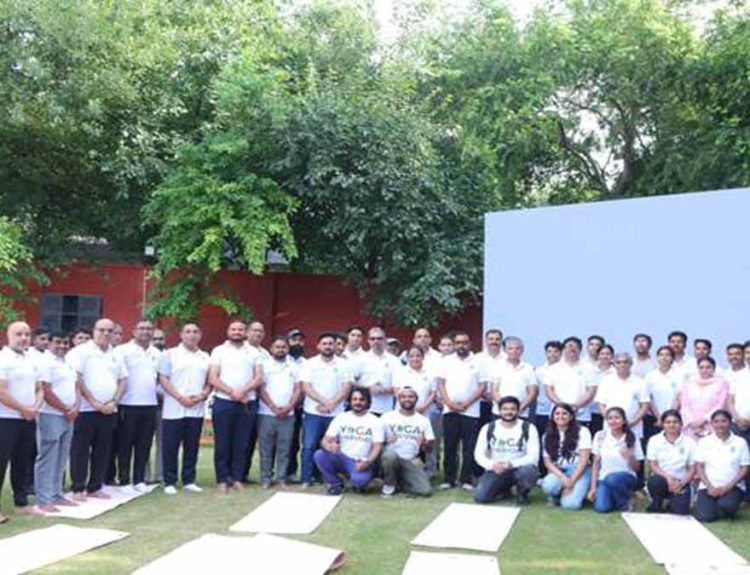

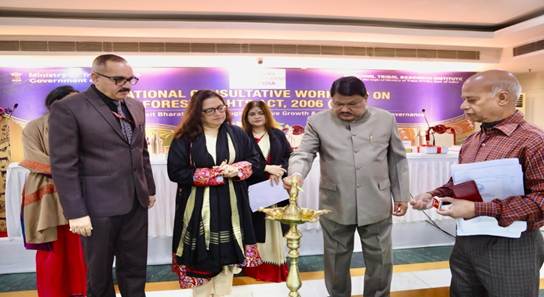

The Ministry of Tribal Affairs (MoTA), in collaboration with the National Tribal Research Institute (NTRI), organized a National Consultative Workshop on the Scheduled Tribes and Other Traditional Forest Dwellers (Recognition of Forest Rights) Act, 2006, today at the Civil Services Officers’ Institute, New Delhi. The workshop was held in alignment with the Hon’ble Prime Minister’s consistent emphasis on restoring the rights, dignity, and livelihoods of the Scheduled Tribes and Other Traditional Forest Dwellers, and his vision of empowering tribal communities through rightful ownership of forest resources as envisaged under the Act. The workshop brought together policymakers, senior officials, legal experts, academicians, and civil society organizations to deliberate on critical challenges and future pathways for strengthening the implementation of the Act.
In the inaugural session, the Hon’ble Union Minister of Tribal Affairs highlighted that the Forest Rights Act, 2006 is a landmark legislation aimed at redressing the historical injustices faced by the Scheduled Tribes and Other Traditional Forest Dwellers. Emphasizing the importance of Community Forest Rights, the Union Minister called upon all stakeholders to share their experiences and propose actionable recommendations emerging from the deliberations. He urged States to prioritize the empowerment of STs and OTFDs through focused interventions, particularly in the protection, value addition, and marketing of Non-Timber Forest Produce (NTFP) such as Sal leaves and Mahua, noting that securing FRA rights is fundamental to ensuring sustainable livelihoods.
Further, the Secretary, Tribal Affairs underlined the role of the Forest Rights Act as a catalyst for tribal welfare and livelihood enhancement. She emphasized the geotagging of all Recognized Forest Rights, including Individual Forest rights (IFR), Community Rights (CR) and Community Forest Resource (CFR) rights, to strengthen transparency and monitoring. She also urged all stakeholders to propose solutions to the key challenges of the FRA regime, with a particular focus on livelihood promotion, digitization of records, and securing habitat rights for Particularly Vulnerable Tribal Groups (PVTGs).
Emphasis was laid on FRA’s role in strengthening tenure security, democratic forest governance, livelihood security, and biodiversity conservation, aligning with India’s vision of Viksit Bharat by Shri. Anant Prakash Pandey, Joint Secretary.
The workshop marked three panel discussions- the first technical session focused on devising strategies and pathways for the incorporation of Records of Forest Rights (RoFR) in government land records, a critical step for achieving legal tenure security. The second panel focused on operationalizing community forest governance under Sections 3(1)(i) and 5 of FRA, and strengthening Gram Sabhas and CFR Management Committees, while the last panel was dedicated to vesting the PVTG habitat rights under FRA. In the first panel, the panelists highlighted that while FRA provides for vesting of pre-existing rights, true tenure security can only be achieved when these rights are accurately recorded in government records. Despite nearly two decades of FRA implementation, several challenges persist, including Complexities in boundary demarcation and ground verification, disputes related to claims and extent of rights, particularly between traditional boundaries and notified forest boundaries.
Key suggestions from the first panel included the need to institutionalize Van Adhikar Kendras with trained personnel to support claimants, especially for demarcation and legal clarity. The importance of integration of revenue and forest records for effective RoFR incorporation. The need for complete digitization of FRA data, uniform data recording formats across States, and integration of legacy data with FRA potential atlases. Further the need for the correction of revenue records prior to digitization.Further, the Deputy Secretary, Shri Ganesh Nagarajan, proposed the creation of a single-window portal to streamline all Forest Rights Act (FRA) processes, including FRA claim management using blockchain technology, digitization of legacy records, and integration with Revenue and Forest Department shape files along with the potential FRA atlas. He informed that such a system is being developed by the Ministry, incorporating a decision support mechanism to identify potential entitlements under other schemes, with the objective of securing and enhancing livelihoods for FRA patta holders.
The second session emphasized the importance of long-term adaptive forest management and the need for facilitation of Gram Sabha federations for convergence. Further, Shri. R. Raghu Prasad, IGF, MoEF&CC, stressed empowering Gram Sabhas as responsible managers of forest resources, and channeling funds from the forest department including the CAMPA funds for preparation and implementation of CFR management plans was also highlighted. Smt. Manjiree Manolkar, Commissioner, TRTI, Maharashtra, shared success stories from Maharashtra, demonstrating a replicable pathway from rights recognition to institutions, livelihoods, and sustainability, supported by clear policy backing through Government Resolutions and multi-stakeholder collaboration has worked for Maharashtra.
In the third session, around PVTG habitat rights, it was discussed that the PVTG habitat rights represent a comprehensive bundle of rights encompassing ancestral traditions, customary practices, and cultural rituals, which require detailed documentation through Form B of FRA. Exemplary cases of the Dongria Kondh, LanjiaSoara in Odisha, where recognition of habitat rights has led to the conferment of Geographical Indication (GI) tags and international recognition by UNESCO for habitat conservation and reduction of drought was also discussed. It was also noted that effective recognition of PVTG habitat rights can also serve as a foundation for landscape-level conservation planning and sustainable governance. As only 3 states to date have managed to recognize the habitats and cultural rights of PVTGs, some of the suggestions by the panelists included issuing directions to all District Collectors in PVTG areas to expedite the implementation of habitat rights and also constituting a working group to facilitate coordinated engagement with district administrations.
The workshop concluded with a consensus on the need for faster and more accurate recording of forest rights in government land records, stronger inter-departmental coordination, capacity building of Gram Sabhas, and the need for enhanced convergence ofthe FRA with development and conservation frameworks. The Ministry of Tribal Affairs reiterated its commitment to strengthening FRA implementation through evidence-based policy reforms, institutional strengthening, and continued engagement with States, experts, and communities.