

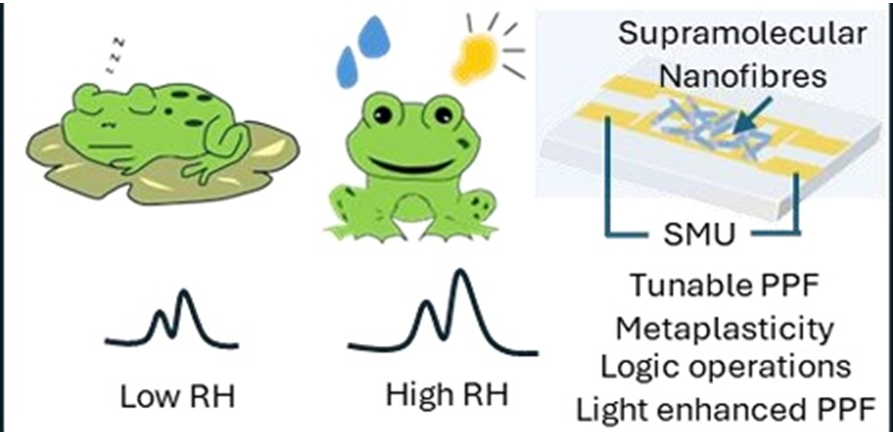

A novel neuromorphic sensor that mimics the response of the brain to environmental changes, primarily humidity, with the ability to process, and store information in a single device, similar to biological systems, could significantly reduce energy consumption and data-processing requirements compared to conventional electronics.
Neuromorphic electronics are gaining importance as conventional computing systems struggle with increasing energy consumption and data processing demands, particularly in applications such as edge computing and artificial intelligence.
Neuromorphic devices, in particular, sensors aim to emulate the functioning of the biological neural systems by integrating sensing, memory, and processing into a single device. Most of the neuromorphic sensors still rely on separate sensing units and memristive elements for processing, which introduces additional energy consumption and data transfer overhead. In contrast, biological sensory systems perform sensing and signal processing simultaneously, making them highly energy efficient and effective. Developing devices that can integrate sensing, memory, and processing in a single platform is therefore crucial for efficient and adaptive systems.
Researchers from Jawaharlal Nehru Centre for Advanced Scientific Research (JNCASR), an autonomous institute of the Department of Science and Technology (DST) have developed a humidity-responsive neuromorphic sensor based on 1D supramolecular nanofibers, capable of integrating sensing and synapse-like information processing in a single device platform. The development of this neuromorphic sensor published in the Journal of Materials Chemistry C was inspired by the amphibian frog, particularly cricket frogs, whose synaptic behaviour is highly moisture sensitive and influenced by daylight.
Tejaswini S. Rao, Sukanya Baruah grew the supramolecular nanofibers from the charge transfer complex of the donor and acceptor molecules. The nanofibers from the water medium were drop coated on the interdigitated gold electrode on a glass substrate to form the active device layer. The device was then placed in a humidity-controlled chamber where relative humidity was regulated using humidified nitrogen flow. Humidity pulses of different strengths and intervals were applied and electrical measurements were performed to examine synaptic responses such as facilitation, depression, and meta plasticity, and to demonstrate basic logic operations.
With the organic nanofibers the researchers developed a tiny device that can sense changes in moisture and respond in a way similar to the way communication happens in the brain. It was found that when the surrounding humidity changes, the current response of the device changes, and it can also temporarily “remember” previous humidity signals it has been exposed to. The response can also be influenced by light in a way similar to that of cricket frog whose activity is also highly sensitive to moisture and daylight. Since the device can sense, process, and store information at the same time, it represents a step toward smart sensors that behave more like natural biological systems.
“This is the first time humidity has been used as the primary stimulus to emulate synaptic behaviour in a neuromorphic device,” the researchers noted.
In the future, this technology could enable smart environmental monitoring systems that respond adaptively to humidity and other environmental signals. It may also contribute to advanced healthcare devices, wearable sensors, and efficient edge-computing technologies used in artificial intelligence and the Internet of Things. By enabling environmentally responsive and energy-efficient computing platforms, the work supports the development of next-generation sustainable electronic technologies.