
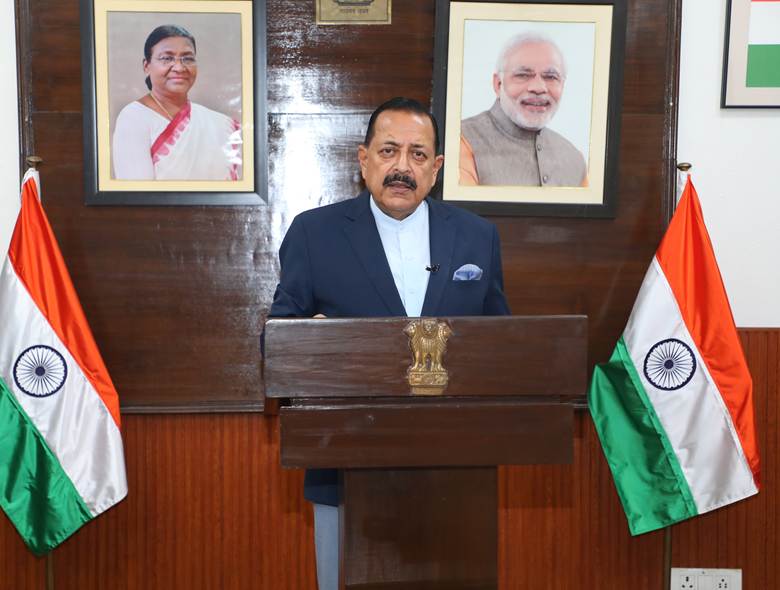

NEW DELHI, April 26: Union Minister of State (Independent Charge) for Science & Technology, Earth Sciences, and MoS PMO, Personnel, Public Grievances, Pensions, Atomic Energy and Space, Dr. Jitendra Singh, called for India to emerge as a global leader in critical and emerging technologies, asserting that technological capability will define national strength in the coming decades.
Addressing the PAN-IIT Alumni Conference in Los Angeles virtually, the Minister said that India must move beyond being a consumer of technology to becoming a creator, designer, and global driver of innovation.
The Minister was speaking at a gathering of distinguished members of the IIT alumni network, comprising global technology leaders, entrepreneurs, researchers, and investors. The conference brought together prominent members of the Indian diaspora, including industry leaders, StartUp founders, and senior professionals contributing to innovation ecosystems across the world.
Dr. Jitendra Singh referred to the vision of Viksit Bharat by 2047, stating that India stands at a defining moment in its development journey, with science, technology, and innovation forming the foundation of future growth. He cited the expanding space programme, advancements in biotechnology, and the rise of deep-tech startups as indicators of India’s growing capabilities.
Emphasizing the role of the Indian diaspora, particularly IIT alumni, he described them as vital connectors between India and global innovation ecosystems. He noted their contribution through investments, mentorship, institutional collaborations, and policy engagement, which continues to strengthen India’s development trajectory.
The Minister acknowledged the significant contribution of the Indian Institutes of Technology in building India’s technology leadership, with alumni leading global corporations, driving cutting-edge research, and shaping public policy. He said the focus now must shift towards identifying the next frontier of growth.
Dr. Jitendra Singh pointed to emerging domains such as semiconductors, artificial intelligence, robotics, and quantum technologies as key to national security, economic resilience, and global competitiveness. He emphasized the need for deeper collaboration between academia, industry, and government, along with new models of education and institution-building.
Referring to the launch of the Sajjan Agarwal School of Technology at Rishihood University, Delhi NCR, he described it as an example of how the global Indian community is contributing to building institutions in India. He said such initiatives, supported by the diaspora, reflect a commitment to strengthening India’s technological base through education linked with real-world applications and entrepreneurship.
Calling for stronger partnerships, Dr. Jitendra Singh said India’s rise will be driven by collective effort involving government, academia, industry, and the global Indian community. He invited IIT alumni to engage more actively in mentoring, investing in research and deep-tech, and collaborating with Indian institutions.
He expressed confidence that with sustained effort and long-term vision, India will not only achieve the goal of a developed nation by 2047 but also contribute significantly to global progress.