

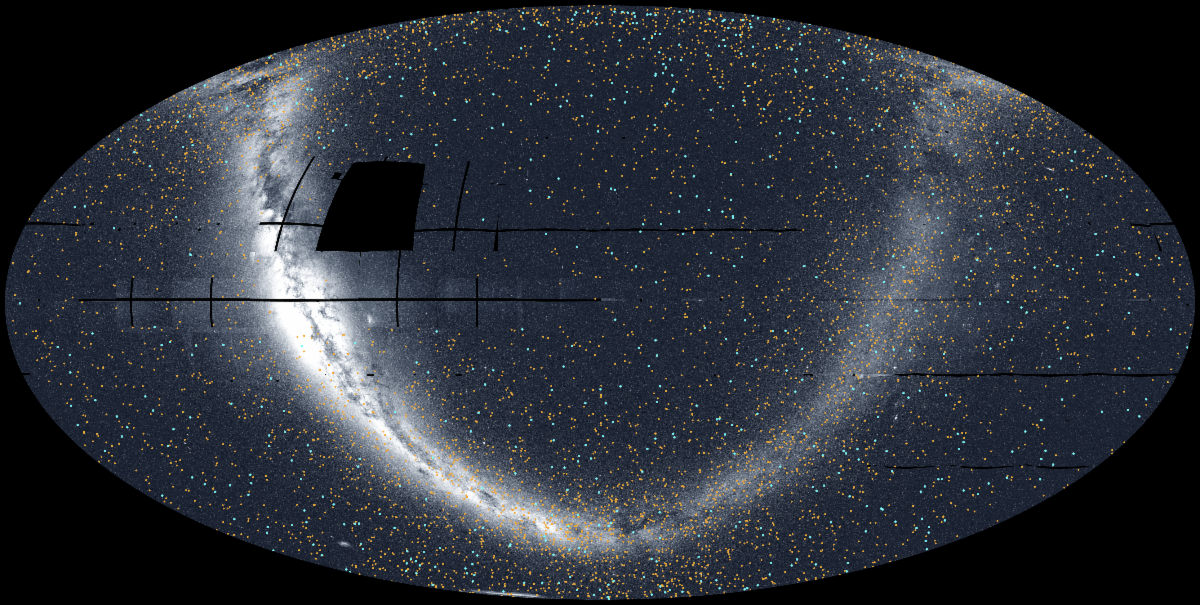

NASA’s Transiting Exoplanet Survey Satellite, or TESS, has released its most complete view of the starry sky to date, filling in gaps from earlier observations. Nearly 6,000 colored dots scattered across the image mark the locations of confirmed or candidate exoplanets — worlds beyond our solar system — identified by the mission as of September 2025.
TESS surveys the entire sky by searching for periodic dips in starlight believed to be caused by planets transiting the host star. Its four identical, red‑sensitive, wide‑field cameras monitor a 24‑degree by 90‑degree strip of sky at a time. Each strip is observed continuously for 27 days at a 2‑second cadence. Over successive years, TESS will tile both the southern and northern hemispheres.
NASA’s Nancy Grace Roman Space Telescope will be the first mission to make detailed studies of the Milky Way’s galactic bulge a core science objective, building on data from earlier observatories such as the Hubble Space Telescope. To help Roman characterize the vast number of stars and planets in this region, astronomers used Hubble to observe many of the same fields that Roman will later examine in its Galactic Bulge Time-Domain Survey. Comparing Hubble’s earlier images with Roman’s new data will give astronomers crucial context, allowing them to interpret Roman’s observations with far greater precision