
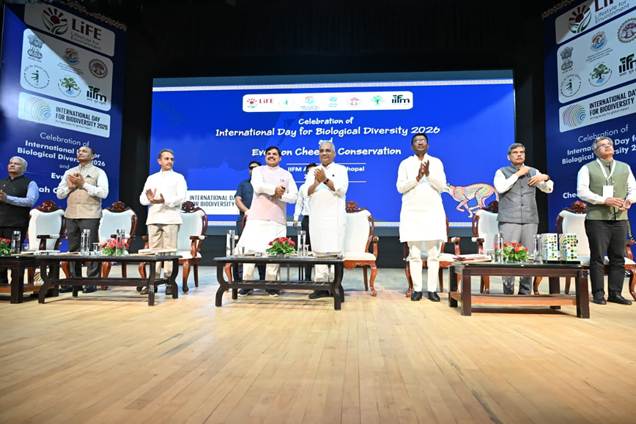

Union Minister for Environment, Forest and Climate Change, Shri Bhupender Yadav, along with Dr. Mohan Yadav, Chief Minister (Madhya Pradesh), presided over the National-Level Celebration of the International Day for Biological Diversity (IDB) 2026 and an Event on Cheetah Conservation at the Indian Institute of Forest Management (IIFM), Bhopal today. The event was based on the theme ‘Acting Locally for Global Impact’, highlighting India’s commitment towards biodiversity conservation, community participation and ecological restoration.
The event was organised by the Union Ministry of Environment, Forest and Climate Change (MoEFCC), in collaboration with the Government of Madhya Pradesh, National Biodiversity Authority (NBA) and International Big Cat Alliance (IBCA). The event was graced by the august presence of other dignitaries present included Shri Kirti Vardhan Singh, Union Minister of State for Environment, Forest and Climate Change and Shri Dileep Ahirwar, Minister of Forest and Environment (Madhya Pradesh). The event also witnessed the presence of senior officials of Union and State Governments, NBA, IBCA, scientists, forest officers, members of Biodiversity Management Committees, researchers, representatives of industries, civil society organisations and students.
Assessing the gathering, Dr. Mohan Yadav, stated that Madhya Pradesh, widely recognised as the ‘Tiger State of India’, has emerged as a major centre for biodiversity conservation and wildlife protection in the country. He highlighted the State’s rich ecological diversity, including forests, wetlands and river ecosystems that support livelihoods and ecological security.
The Chief Minister highlighted the reintroduction of Cheetahs in Madhya Pradesh as a landmark achievement in India’s conservation journey and a symbol of ecological restoration and biodiversity recovery. He noted that Project Cheetah has strengthened habitat conservation, scientific wildlife management and community participation in conservation efforts.
Dr. Yadav further emphasised that Madhya Pradesh has taken significant steps towards strengthening biodiversity governance through Biodiversity Management Committees and preparation of People’s Biodiversity Registers, thereby empowering local communities to conserve traditional knowledge and biological resources.
In his address, Shri Bhupender Yadav stated that the theme of International Day for Biological Diversity 2026 ‘Acting Locally for Global Impact’ underscores the importance of empowering communities and local institutions for achieving environmental sustainability and ecological security. He emphasised that meaningful global outcomes can emerge only through strong local action, community participation and sustainable lifestyles.
The Minister also highlighted India’s rich biodiversity heritage and traditional ecological knowledge systems, noting that India, as one of the world’s megadiverse countries, possesses diverse ecosystems ranging from the Himalayas and forests to wetlands, grasslands, deserts, coastal and marine ecosystems. He observed that community-led conservation traditions such as sacred groves, folk varieties, landraces and local stewardship practices demonstrate the deep cultural and ecological relationship between people and nature.
The Minister noted that conservation thinking has evolved from focusing only on single species to protecting the entire spectrum of life and interconnected ecosystems. He said that ecological scientists have increasingly recognized that plants and animals cannot survive in isolation, but depend upon complex and interdependent ecological systems. He added that conserving overall biodiversity strengthens nature’s resilience and adaptive capacity against challenges such as climate change.
Shri Yadav reiterated India’s commitment towards implementation of the Convention on Biological Diversity and the Kunming-Montreal Global Biodiversity Framework. He stated that the Biological Diversity Act, 2002 has established a strong decentralised institutional framework through the National Biodiversity Authority, State Biodiversity Boards and Biodiversity Management Committees (BMCs).
The Minister also stated that the recent amendments to the BD Act, Rules and Regulations provide conducive environment for the industries and facilitates ease of doing business. This resulted in getting due benefits by the local communities from the industries. Highlighting the progress achieved under the Access and Benefit Sharing (ABS) mechanism, the Minister stated that nearly Rs.145 crore has been released to beneficiaries across the country, benefiting around 11,000 Biodiversity Management Committees. The Minister requested the Chief Minister (Madhya Pradesh) to facilitate village level BMCs by transfer of ABS benefits, which would increasingly empower them to work in the direction of biodiversity conservation in mission mode.
Shri Yadav stated that Project Cheetah, launched in 2022 through the world’s first intercontinental translocation of a large carnivore, reflects India’s strong commitment towards ecological restoration, biodiversity conservation and revival of grassland ecosystems. He noted that the successful adaptation and breeding of cheetahs in India represent encouraging progress in long-term species recovery and habitat restoration efforts.
Addressing the event, Shri Kirti Vardhan Singh, emphasised that biodiversity conservation is intrinsically linked to food security, water security, livelihoods, climate resilience and sustainable development. He underlined the importance of India’s traditional ecological wisdom and sustainable lifestyles, including the global movement of Lifestyle for Environment (LiFE). Conversation on Biodiversity forms the bedrock of all environmental protection actions, he said.