

The Thread That Connects Millions
Imagine fields stretching across India where tiny white blossoms slowly turn into soft clouds of fibre under the sun. From these fields begins a journey that threads through spinning mills, handlooms, and finally reaches wardrobes across the world. Cotton is not merely a crop. It is a thread that binds agriculture, industry, and trade into one continuous story.
Cotton is one of the most important commercial crops cultivated in India. It accounts for around 23 percent of global fibre production. The crop supports the livelihoods of around 6 million cotton farmers. It also sustains employment for another 40-50 million people engaged in related activities such as cotton processing and trade. Beyond clothing, cotton plays a vital role in earning foreign exchange through exports of fibre, yarn, fabrics and garments. Due to its economic importance in India, it is also termed as “White-Gold”.
India’s cotton sector reflects both depth and dynamism. Its strength lies in biological diversity, extensive cultivation, and a robust textile ecosystem. Policy interventions, including MSP operations, the Mission for Cotton Productivity, and Kasturi Cotton Bharat, are reinforcing this foundation. Technology adoption, market reforms, and quality enhancement efforts are further shaping the sector’s future trajectory.
From Swadeshi to Atmanirbhar Bharat
India’s association with cotton stretches back thousands of years. The subcontinent was once a global centre for cotton textiles, trading its fabrics across Eastern and European markets. In ancient times, cotton cloth even functioned as a medium of exchange. This highlighted its economic value and widespread acceptance.
The modern cotton industry began taking shape in the 19th century with the establishment of textile mills in Kolkata, Mumbai, and Ahmedabad. The latter earned the title “Manchester of India”. Expansion gathered pace in the late 19th and early 20th centuries. The Swadeshi movement promoted the establishment of Swadeshi Mills to contest against British goods. Global demand during the World Wars further boosted the domestic industry. By the mid-20th century, the number of textile mills had risen steadily across the country. This resulted in a significant increase in cotton cloth production in the years leading up to Independence. This reflected the expanding scale and resilience of India’s cotton industry.
The Many Dimensions of India’s Cotton Sector
India is the only country that cultivates all four recognized cotton species. These include G. Arboreum and G. Herbaceum, commonly referred to as Asian cotton. The other species are G. Barbadense, known as Egyptian cotton, and G. Hirsutum, known as American upland cotton. Among these, G. Hirsutum accounts for nearly 90 percent of hybrid cotton production in India. All Bt cotton hybrids currently cultivated in the country belong to this species.
Bt refers to Bacillus thuringiensis, a naturally occurring soil bacterium. Bt cotton is a genetically modified cotton crop that incorporates genes from this bacterium. These genes provide resistance against bollworms, a major pest affecting cotton cultivation. Introduced commercially in India in 2002, Bt cotton significantly reduced bollworm infestation and lowered the need for insecticide sprays. The combined effect of higher yields and reduced pest control costs contributed to improved farm incomes following its adoption.
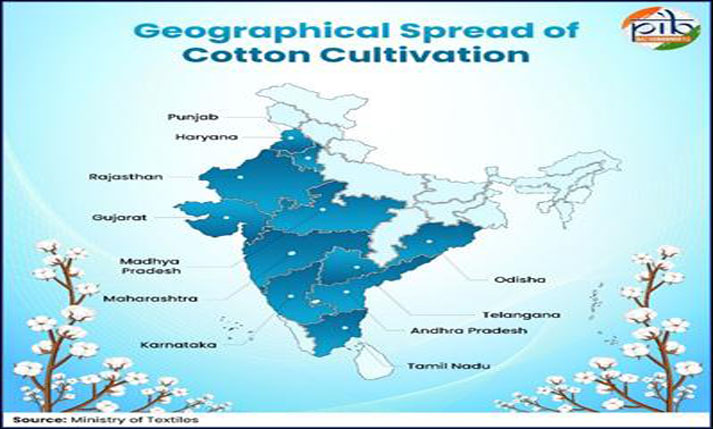
Cotton production in India is largely concentrated in 9 major states, grouped into 3 distinct agro-ecological zones:
• Northern Zone comprising Punjab, Haryana, and Rajasthan
• Central Zone comprising Gujarat, Maharashtra, and Madhya Pradesh
• Southern Zone comprising Telangana, Andhra Pradesh, and Karnataka
In addition to these states, cotton is also grown in Odisha and Tamil Nadu.
India’s Cotton Strength in Area, Production, and Consumption
India ranks first in the world in cotton cultivation area (in hectares), with 114.84 lakh hectares devoted to the crop. This accounts for around 38 percent of the global cotton area of 304.08 lakh hectares. A large share of the country’s cotton production depends on rainfall, with approximately 62 percent grown in rain-fed regions. The remaining 38 percent is cultivated under irrigated conditions.
India ranks second globally in both cotton production and consumption. This shows the scale of its cultivation base and the strength of its textile industry. Cotton production is commonly reported in bales; it is the standard unit used in the cotton trade. One bale is equivalent to 170 kg. During the 2024-25 cotton season, cotton production pegged at 297.24 lakh bales (5.06 million tonnes). This accounts for nearly 20 percent of global cotton output.
For 2025-26 (provisional), cotton production stood at 290.91 lakh bales (4.95 million tonnes). Domestic consumption, including Micro, Small, and Medium Enterprises (MSME), non-MSME, and non-textile segments, stood at 328 lakh bales (5.58 million tonnes). These reflect India’s prominent position in the global cotton economy.
Cotton Exports and India’s Trade Footprint
India continues to maintain a strong presence in the global cotton trade. In 2024-25, the country exported an estimated 18 lakh bales, equivalent to 0.31 million metric tonnes. This accounts for about 3.37 percent of total world exports, amounting to 541.69 lakh bales (9.21 million metric tonnes). This reflects India’s role as a significant exporter in the international cotton market.
Further, India exports cotton to several major global markets, reflecting strong and diversified international demand. In value terms, cotton exports reached US$ 11.49 billion in FY25. The United States of America emerged as the largest destination for Indian cotton fabrics and made-ups exports, accounting for 26.35 percent of cotton exports. This was followed by Bangladesh at 19.81 percent and Sri Lanka at 5.11 percent. Other important destinations included the United Kingdom, with a share of 2.38 percent, and the United Arab Emirates, at 2.32 percent.