


New Era of Peace and Security
For nearly six decades, India grappled with Left-Wing Extremism (LWE). It was not a distant or abstract challenge, but a lived reality for millions of tribal families, villages cut off from roads, schools, and the broader promise of inclusive development. Violence was persistent, and uncertainty defined everyday life.
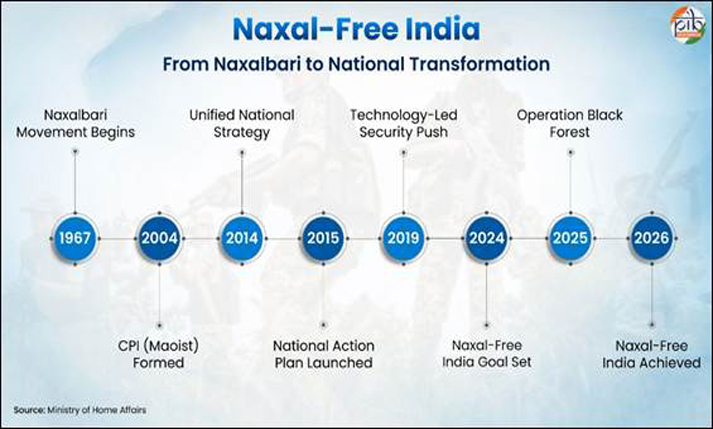
On 31 March 2026, this changed, marking a historic milestone in India’s internal security journey as the country became effectively free from Naxalism. When the current government assumed office in May 2014, the Red Corridor remained one of the most serious internal security challenges. Earlier approaches were largely fragmented and incident-driven, managing symptoms rather than addressing the structural roots of the problem. A more comprehensive and integrated strategy was subsequently pursued to resolve it.
Over the last twelve years, the transformation was guided by three mutually reinforcing strands of action. Restoring trust and faith involved strengthened security operations, improved inter-agency coordination, structured surrender and rehabilitation frameworks, and sustained community outreach. Expanding infrastructure meant improving physical and digital connectivity, extending governance presence into remote areas, and creating durable economic opportunities. Delivering welfare focused on dignity, inclusive service delivery, cultural inclusion, and the mainstreaming of affected communities into the national development process.
Each of these strands reinforced the other. Security created space for development. Development deepened trust. Trust accelerated welfare delivery. It was not a sequence; it was an inseparable chain of progress.
Restoring Faith in the State
This effort focused on rebuilding trust and faith through sustained state presence in vulnerable and remote regions. It strengthened coordination between security agencies and governance institutions to ensure effective responsiveness. The approach bridged long-standing gaps between communities and the state system.
Peak of Violence Before 2014
LWE grew from the Naxalbari uprising of West Bengal in 1967, inspired by Maoist ideology and the doctrine of armed revolution. Its guiding principle was simple and violent: power flows from the barrel of the gun. Nearly 92 per cent of Naxalites’ weapons were looted directly from police armouries. Over time, several extremist organisations merged under CPI (Maoist) in 2004, making it India’s biggest internal security challenge.
The decade from 2004 to 2014 was among the most violent in LWE history. Violence peaked in 2010 with 1,936 incidents and 720 civilian deaths in a single year. The full decade recorded 17,542 violent incidents, 1,913 security force deaths, and 5,019 civilian deaths.
There was no consistent national policy. State governments operated in silos. Even then government publicly acknowledged in 2009 that Naxalism was the biggest internal security challenge facing India, one that exceeded even Kashmir and the Northeast in geographic spread.
Policy Shift: From Scattered Response to Unified Strategy
The first decisive action came in 2015 with the approval of the National Policy and Action Plan to address LWE. This replaced the earlier, ad hoc approach with a structured, whole-of-government framework. It deployed Central Armed Police Forces (CAPF), provided specialised training, and allocated funds through the Security Related Expenditure, Special Infrastructure Scheme, and Special Central Assistance (SCA) schemes, while addressing socio-economic root causes alongside security. Till now, approximately ₹4,289.20 crore have been released since the inception of SCA Scheme in 2017.
Under the Special Infrastructure Scheme (SIS), projects worth ₹1,761 crore have been sanctioned for LWE-affected States to strengthen Special Forces, Special Intelligence Branches, District Police and the construction of Fortified Police Stations.
Since 2014-15, ₹3,805.04 crore has been released under the Security Related Expenditure (SRE) Scheme to support operational needs, capacity building and training of security forces, rehabilitation of surrendered Left Wing Extremism cadres, and ex gratia assistance to families of martyred security personnel and civilians.
For the first time, India implemented a structured and comprehensive approach based on three-pronged strategy against LWE- Dialogue, Security, and Coordination. The government’s response was guided through a more centrally coordinated framework under the Ministry of Home Affairs, bringing greater coherence to policy implementation.