
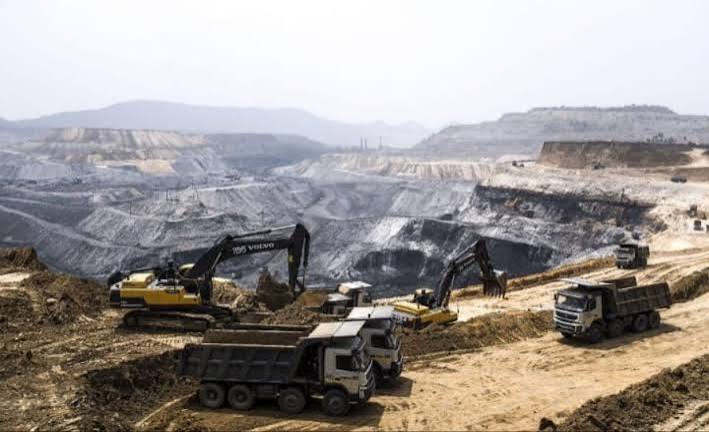

Over the last five years, the Government has carried out a series of structural and procedural reforms to make coal allocation and mining more transparent, efficient, and scientific. The key change has been the shift from allotment to allocation through open competitive auction, alongside the opening of commercial coal mining in 2020 with no restriction on the sale or end-use of coal.
1. Key Reforms for Transparency and Market-Based Allocation:
Commercial Coal Mining: Opened with no technical or financial eligibility conditions, and 100% Foreign Direct Investment (FDI) has been allowed under the automatic route.
Revenue-Share Model: Auctions have migrated to a percentage revenue-share model, supported by the introduction of the National Coal Index for transparent, market-linked pricing.
Single Window Mode Agnostic (SWMA) Auction: Introduced to sell all non-linkage coal of Coal India Limited (CIL) through a single window, removing market distortions and enhancing fair competition amongst buyers.
SHAKTI Policy Simplification: Coal linkage allocation has been simplified into two windows—Window I at Notified Price and Window II at a Premium above Notified Price, enabling existing linkage consumers to procure up to 100% PLF requirement.
CoalSETU Window: Introduced under the Non-Regulated Sector (NRS) Linkage Auction Policy to provide auction-based linkages without end-use restrictions, allowing full flexibility for self-consumption, coal washing, or export.
2. Reforms for Efficiency and Ease of Doing Business:
Single Window Clearance System: Introduced through the PARIVESH 2.0 portal for faster mine operationalization.
Exploration: 44 private entities have been notified as Accredited Prospecting Agencies (APA), removing the need for a prospecting license. The Geological Reports approval mechanism has also been simplified.
Statutory Amendments: The Colliery Control Rules have been amended to empower coal company boards to accord Mine Opening Permissions. Furthermore, Coking Coal has been notified as a Critical and Strategic Mineral under the MMDR Act, 1957, thereby, expediting Environment Clearance and Forest Clearance process for Coking Coal Projects
Mine Developer and Operator (MDO) Mode: The Government has introduced the Mine Developer and Operator mode for coal mining and has also offered closed/abandoned mines under a revenue-sharing model to maximize resource extraction.
Insurance Surety Bond has been included as an acceptable instrument for furnishing Performance Security in the Coal Block Development and Production Agreements. This will reduce dependence on Bank Guarantees, release blocked working capital and widen participation.
The Government has taken several initiatives to modernise the coal ecosystem through technology adoption and clean coal initiatives:
Coal Washing: Under ‘Mission Coking Coal’, the Government aims to enhance the country’s coal washery capacity to 58 MT by FY 2030.
Digital Mine Monitoring: The Ministry of Coal has launched the Koyla Shakti Dashboard for real-time monitoring of coal production, dispatch, stocks, and transportation. Additionally, the Khanan Prahari mobile app and CMSMS web app have been deployed nationally for citizen-based reporting of unauthorized mining activities. CIL has also deployed Integrated Command and Control Centres (ICCC) with AI-based video analytics, RFID-enabled weighbridges, GPS-based vehicle tracking, and drone/satellite-based mapping for scientific mine planning.
Coal Gasification & UCG: To promote surface coal/lignite gasification, the Government has approved two major schemes with financial outlays of ₹8,500 crore (under which 8 projects are already approved) and ₹37,500 crore to meet the target of 100 MT gasification capacity by 2030.
Renewable Energy & Carbon Capture: CIL has adopted a phased renewable energy roadmap with a target of 3 GW of net-zero renewable capacity by FY 2027-28 and 9.5 GW by FY 2029-30, with 558 MW already installed across utility and captive projects.
Coal continues to play a vital role in meeting the country’s energy needs and supporting industrial growth.
Further, the Government promotes environmental sustainability in coal mining through initiatives such as plantation/bio-reclamation, development of eco-parks, and mine water utilization. Blast-free mining technologies (like Surface Miners) are being aggressively adopted to replace conventional drilling.
India’s domestic coal production has increased significantly from about 731 million tonnes in 2019-20 to cross 1 Billion Tonnes for two consecutive years, reaching 1047.52 MT in FY 2024-25 and 1039 MT in FY 2025-26.
The Government has launched an Integrated Coal Logistics Plan aiming to develop a technology-enabled, cost-effective multimodal logistics ecosystem through rail, road, coastal shipping, and inland waterways. A total of 139 First Mile Connectivity (FMC) projects with an aggregate capacity of about 1,319 million tonnes have been taken up, out of which 72 projects with a capacity of about 589 million tonnes have already been commissioned
To further streamline the sector, the Government has notified the Coal Exchange Rules, 2026 to establish a regulated online platform for trading coal and its processed forms. The Coal Exchange will enable captive/commercial miners and consumers to enter into delivery-based contracts.
This information was given by Union Minister of State for Coal and Mines Shri Satish Chandra Dubey in a written reply in Lok Sabha today.