

National Institute of Sowa-Rigpa (NISR) Should Become a Global Centre for Holistic Wellness: Shri Prataprao Jadhav
Union Ayush Minister Chairs 2nd Governing Body Meeting of the National Institute of Sowa-Rigpa
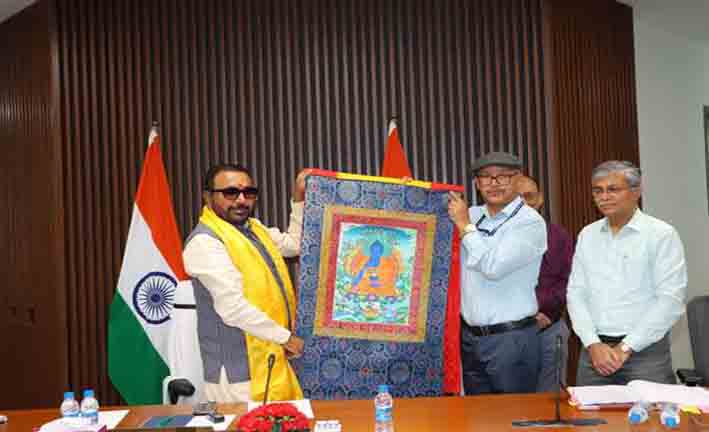
The Union Minister of State (Independent Charge) for Ayush and Minister of State for Health & Family Welfare, Shri Prataprao Jadhav, chaired the 2nd Governing Body Meeting of the National Institute of Sowa-Rigpa (NISR) in New Delhi and outlined a strategic roadmap for strengthening Sowa-Rigpa through scientific research, academic excellence, institutional development and expansion across the Indian Himalayan Region (IHR).
Setting out the Institute’s priorities for the coming years, the Union Minister Shri Prataprao Jadhav emphasised that the next phase of growth should focus on strengthening scientific research, promoting international standards and expanding the reach of Sowa-Rigpa beyond its traditional geographical boundaries.
Addressing the Governing Body, Shri Prataprao Jadhav said, “Our goal is no longer limited to developing infrastructure; it is to establish Sowa-Rigpa as a mainstream healthcare system in India and across the world. Our foremost commitment is to establish Sowa-Rigpa as an evidence-based system of medical science before the world. To achieve this, we must accelerate our research strategies, and the establishment of an independent research council will be the first important step. We must build an ecosystem that integrates traditional wisdom with scientific excellence through evidence-based research, strong academic institutions and globally accepted standards.”
Shri Prataprao Jadhav further said, “I firmly believe that the National Institute of Sowa-Rigpa is not merely an institution of Ladakh; it is the custodian of the medical heritage of the entire Indian Himalayan Region. We must strengthen both of its regional models and deepen our engagement with the Himalayan communities. Greater focus should be given to sustainable cultivation of rare medicinal plants, bio-prospecting, agroforestry and conservation of medicinal biodiversity so that local communities become equal partners in preserving and promoting this invaluable knowledge system. Together, let us transform this institution into a global centre for holistic wellness.”
Shri Jadhav suggested that hundreds of Bhoti language manuscripts containing the invaluable knowledge and heritage of Sowa-Rigpa should be preserved through systematic transcription and translation. He proposed that, as a first step, these manuscripts be digitised, followed by their translation to make this rich repository of knowledge accessible to the general public and researchers. He further proposed that the digitisation drive be accelerated with the work being undertaken by NISR, the Gyan Bharatam Mission or any other competent institution, and, if required, through collaboration with the Ministry of Culture. He emphasised that preserving and digitising this invaluable knowledge is essential for safeguarding India’s traditional medical heritage and strengthening future research in Sowa-Rigpa.
Secretary, Ministry of Ayush, Vaidya Rajesh Kotecha, said that the Ministry is committed to building strong institutions that preserve India’s traditional medical knowledge while advancing it through modern scientific approaches. He noted that NISR has emerged as a key institution for promoting Sowa-Rigpa through quality education, clinical services, research and capacity building, and reaffirmed the Ministry’s continued support for its long-term development.
The Governing Body also congratulated Dr. Padma Gurmet, Director, National Institute of Sowa-Rigpa, on being conferred the Padma Shri in 2026 in recognition of his outstanding contributions to the field of medicine, particularly for his pioneering efforts in reviving, preserving and institutionalising the ancient Sowa-Rigpa system of medicine in India. The members appreciated his leadership in advancing Sowa-Rigpa through education, research, clinical services and institutional development.
Dr. Padma Gurmet presented the Institute’s progress and future action plan before the Governing Body. He highlighted achievements in academics, clinical services, research, medicinal plant conservation and outreach programmes, while outlining proposals aimed at further strengthening institutional capacity and expanding the reach of Sowa-Rigpa across the country.
Sowa-Rigpa, meaning “Knowledge of Healing” in the Bhoti language, is one of the world’s oldest traditional systems of medicine and has been recognised by the Government of India under the Ayush framework. Popularly known as the Amchi system of medicine, it is practised across the Indian Himalayan Region and several neighbouring countries. Over centuries, the system evolved and flourished across the Trans-Himalayan region and today represents a rich repository of traditional medical knowledge.
The Governing Body deliberated on key policy, academic and research initiatives aimed at strengthening the National Institute of Sowa-Rigpa as the apex institution for education, research and healthcare in Sowa-Rigpa. The Ministry of Ayush reaffirmed its commitment to advancing this ancient Himalayan medical tradition through scientific validation, institutional excellence and wider public outreach.