

Makhana, scientifically known as Euryale ferox, is an aquatic crop grown mainly in shallow ponds, lakes, and wetlands. The edible part of the plant is its seed. After roasting or processing, the seed is popped and consumed as a fox nut. India is the world’s largest producer of makhana. This position is supported by suitable agro-climatic conditions and long-standing cultivation practices, mainly in Bihar, West Bengal, and Assam.
Over the years, makhana has evolved from a traditional food of Bihar into a widely consumed health food across the country. This transformation has been driven by rising health awareness and supportive government policies. The growth of startups producing value-added makhana products and the increasing role of Farmer-Producer Organizations (FPOs) have also contributed to the sector’s expansion. In line with the sector’s growing importance, the Government announced the establishment of the National Makhana Board in the Union Budget 2025-26. The Board was formally launched in Bihar on 15 September 2025. This initiative marks a significant step towards strengthening and modernizing the makhana value chain.
To further support the sector, the Government has approved a Central Sector Scheme for the Development of Makhana with a total outlay of ₹476.03 crore for the period from 2025-26 to 2030-31. The scheme focuses on promoting research and innovation, improving the availability of quality seeds, and strengthening farmers’ skills. It also aims to upgrade harvesting and post-harvest practices, promote value addition, branding, and marketing, enhance exports, and reinforce quality control systems. Under the Central Sector Scheme for the Development of Makhana, ₹30 Crore was approved for 2025-26 and ₹90 Crore for 2026-27.
India’s Makhana Boom
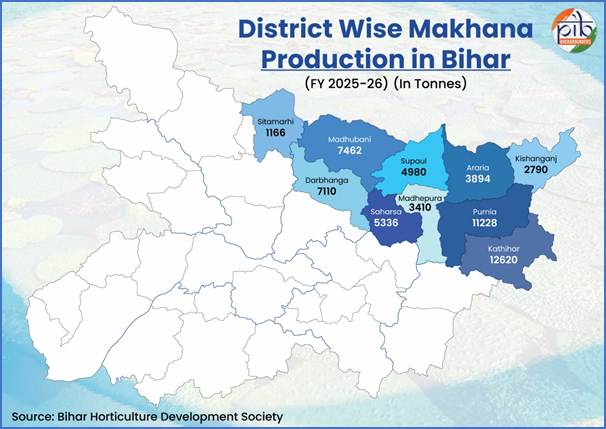
India continues to be the clear global leader in makhana production. Bihar accounts for nearly three-fourths of India’s Makhana production and contributes around 80-85% of the global supply. Makhana cultivation is mainly concentrated in North Bihar.
It is especially prominent in the Kosi basin districts of Supaul, Saharsa, and Madhepura, as well as in nearby areas of the Mithila and Seemanchal regions. This makes the state the central hub of the makhana sector.
In 2024-25, as per final estimate of Horticulture Statistics Unit, DA&FW, the total production of makhana in India was 63,910 Metric Tonnes (MT), with an average productivity of 2.03 MT per hectare. As per the Second Advance Estimates (2025–26), total production of makhana in India is 80,590 MT, with an average productivity of 2.34 MT per hectare. Bihar is the leading producer of makhana in the country, with a production of 60,000 MT in 2025–26 and average productivity of 2.00 MT per hectare.
Traditionally grown in ponds, modern techniques like field-system farming and improved varieties such as Swarna Vaidehi and Sabour Makhana-1 have helped increase productivity. The growth has been driven by an increase in cultivated area, improved productivity, and reduced cultivation risks.
It is especially prominent in the Kosi basin districts of Supaul, Saharsa, and Madhepura, as well as in nearby areas of the Mithila and Seemanchal regions. This makes the state the central hub of the makhana sector.
In 2024-25, as per final estimate of Horticulture Statistics Unit, DA&FW, the total production of makhana in India was 63,910 Metric Tonnes (MT), with an average productivity of 2.03 MT per hectare. As per the Second Advance Estimates (2025–26), total production of makhana in India is 80,590 MT, with an average productivity of 2.34 MT per hectare. Bihar is the leading producer of makhana in the country, with a production of 60,000 MT in 2025–26 and average productivity of 2.00 MT per hectare.
Traditionally grown in ponds, modern techniques like field-system farming and improved varieties such as Swarna Vaidehi and Sabour Makhana-1 have helped increase productivity. The growth has been driven by an increase in cultivated area, improved productivity, and reduced cultivation risks.
Text Box: Makhana-Geographical Indication (GI) Tag“Mithila Makhana” has been granted a GI tag, recognizing the unique quality, reputation, and traditional knowledge associated with makhana produced in the Mithila region of Bihar. The GI status provides legal protection, enhances market differentiation, and strengthens branding potential in domestic and international markets.
Domestic Production and Consumption Dynamics in Makhana Market
India produces more than 0.6 lakh metric tonnes of makhana each year. About 40 percent, or nearly 0.23-0.25 lakh metric tonnes, is exported, while the remaining quantity is consumed domestically. With growing global demand for clean-label and plant-based superfoods, India’s strong production base places makhana as a premium snack in international markets.
The domestic makhana market recorded annual growth of 17-18 percent between 2021-22 and 2024-25. This growth has been driven by rising health awareness, premiumization, and the expansion of branded players. Strong domestic demand has also helped shield the sector from fluctuations in export markets.
The market is expected to reach ₹11,000-12,000 crore by 2029-30. Production volumes increased by only 4 to 5 percent during the period from FY 2022 to 2025. Average prices increased from about ₹500 per kilogram during 2020-2022 to nearly ₹1,250 per kilogram in 2025. This increase is linked to higher demand for health-focused snacks, premium branding, and limited supply response.
Estimated Monthly Domestic Consumption (Popped)
India’s monthly domestic consumption of popped makhana is estimated at 3,000-3,500 metric tonnes. During festive periods, when demand for snacks peaks, consumption rises to around 5,000 metric tonnes.
Within domestic consumption, branded Fast-moving consumer goods (FMCG) and organized snack players account for 1,800-2,000 metric tonnes per month. This is driven by the rapid premiumization of the category and the expansion of retail penetration. Loose and unorganized retail contributes 1,200-1,400 metric tonnes per month, remaining significant in Tier-2 and Tier-3 markets, even as packaged formats gradually gain popularity.
Local Fields Serving Global Shelves: Export Journey
Prior to 2025, makhana was classified under general Harmonized System of Nomenclature (HSN) codes. This resulted in the non-availability of product-specific export data. To address this gap, the Directorate General of Foreign Trade (DGFT) introduced a separate HSN code for popped makhana and other makhana products in 2025. In 2025–26, India exported 7,264.89 MT of makhana products (export value 19296.08 lakh).