

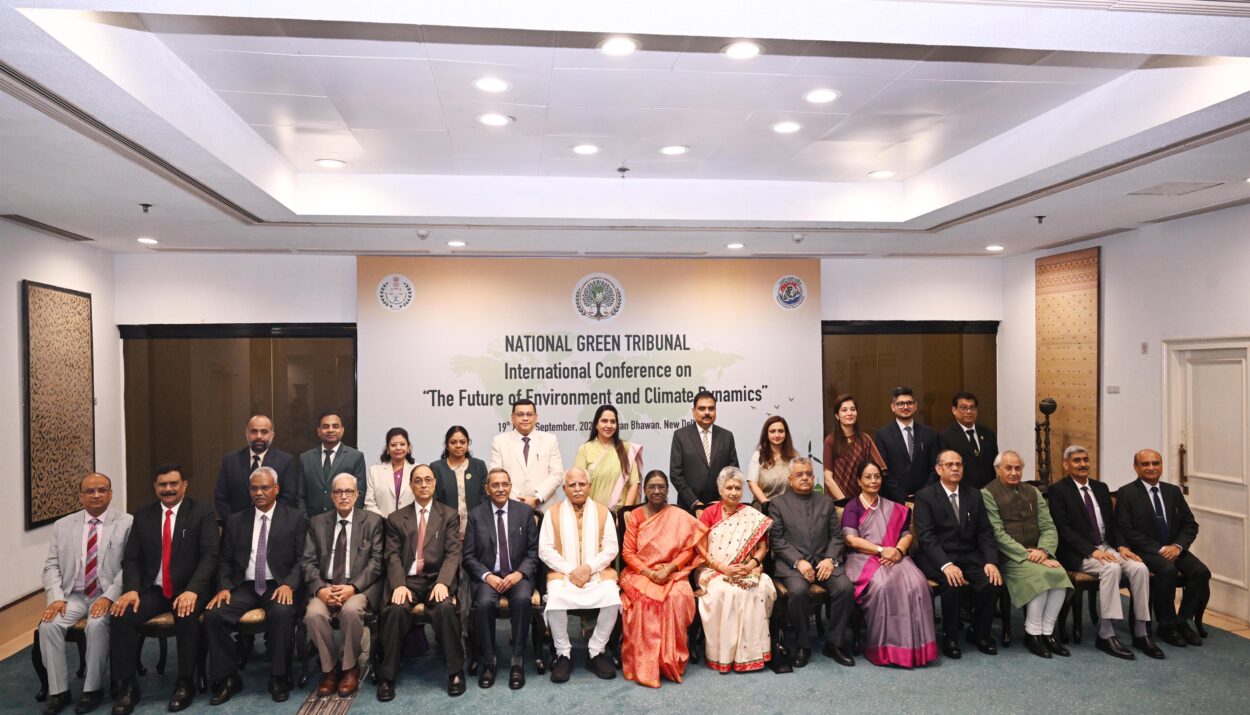

The President of India, Smt Droupadi Murmu graced the valedictory session of the International Conference on ‘The Future of Environment and Climate Dynamics’, organized by the National Green Tribunal, in New Delhi today (September 20, 2026).
Speaking on the occasion, the President said that climate change creates imbalances across multiple levels of human existence. Issues such as biodiversity loss, water stress and land degradation are deeply intertwined with it. Climate change is also having serious repercussions on food security, health, and livelihoods.
The President said that a well-structured framework of policies and actions is essential to effectively address such a complex challenge. The framework must ensure the active participation of not only governments and legal experts but also the communities most affected by climate change. Special sensitivity towards the needs of rural and forest-dwelling societies, small farmers, women, and other vulnerable communities is crucial, as they bear the brunt of natural disasters.
The President underlined that traditional knowledge systems, along with the practices and lived experiences of local communities, play a vital role in enhancing climate adaptation capacity. She said that we must strengthen climate resilience through people-centric and community-based adaptation approaches rooted in traditional knowledge. She stated that sustainable afforestation can also play a significant role in enhancing climate resilience. Afforestation efforts that nurture biodiversity and are aligned with local conditions can be instrumental in this regard. She stated that the true objective of sustainable afforestation is not merely planting trees, but rather restoring healthy and self-sustaining ecosystems.
The President said that developing countries should chart a path that enhances resilience while maintaining the pace of development. Commitments to responsible climate action must align with the country’s development needs and economic aspirations. They must also be technically feasible. She was happy to note that many such aspects have been discussed at the Conference.
The President said that India has done commendable work in fostering environmental awareness by engaging common citizens, especially the youth. The Government of India’s ‘Mission LiFE’ initiative has demonstrated that meaningful strides towards ecological restoration can be achieved through public participation and community ownership.
The President appreciated the National Green Tribunal for bringing experts, judges, jurists, and key stakeholders from various countries, who are active in environmental issues, on one platform. She expressed confidence that deliberations and action plans from this Conference will contribute to paving the way for building climate-resilient societies, grounded in inclusive policies and effective actions.