
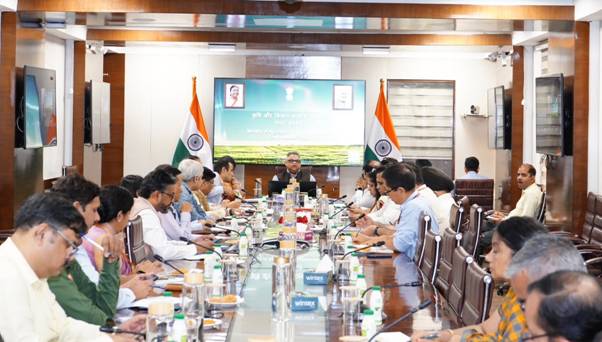

Union Minister for Agriculture and Farmers’ Welfare, and Rural Development, Shri Shivraj Singh Chouhan today emphasised that cleanliness should not remain confined to the duration of a campaign, but should become an integral part of people’s behaviour and everyday lives. Addressing a virtual meeting with the Secretaries and senior officials of the Ministry of Agriculture and Farmers’ Welfare and the Ministry of Rural Development, he called for active participation by officials and employees in cleanliness activities and urged them to lead by example. He also stressed the need to continuously strengthen awareness and participation around cleanliness in offices, workplaces, field offices and rural areas. Shri Chouhan said that sustained efforts, rather than activities limited to a defined campaign period, are essential to make cleanliness a lasting practice and a shared responsibility across institutions and communities.
Shri Chouhan said that Swachhata Hi Seva 2026 requires extensive public participation to ensure that cleanliness activities are both effective and sustainable. He directed officers and employees to give priority to cleanliness within their respective areas of work and to take the initiative themselves rather than treating such activities merely as an official requirement. He placed particular emphasis on effectively connecting rural areas, panchayats and field-level offices with cleanliness activities and ensuring the participation of farmers, rural communities, sanitation workers, the media and other relevant stakeholders. He stressed that the involvement of these groups is important for taking cleanliness efforts beyond government offices and making them more visible and meaningful at the grassroots level. Active participation by all concerned, he said, would help create greater awareness and encourage cleanliness to become part of routine practices in communities.
The Union Minister directed that cleanliness activities should not be reduced to a formality, but should produce clear and measurable outcomes. He emphasised the need for systematic documentation of the work undertaken as part of the campaign so that the results and impact of the activities can be properly assessed. Wherever possible, he called for achievements to be recorded through before-and-after photographs, enabling the changes brought about through cleanliness initiatives to be clearly documented. He stressed that such documentation would help demonstrate the tangible results of the campaign and ensure that the work undertaken is properly recorded for future review. The focus, he said, should remain on visible improvements, measurable outcomes and sustained efforts rather than simply completing activities within the stipulated campaign period.
During the meeting, Shri Atish Chandra, Secretary, Department of Agriculture and Farmers’ Welfare; Dr Mangi Lal Jat, Secretary, Department of Agricultural Research and Education (DARE) and Director General, Indian Council of Agricultural Research (ICAR); Shri Rohit Kansal, Secretary, Department of Rural Development; and Shri P Narhari, Joint Secretary, Department of Land Resources, briefed the Union Minister on cleanliness activities being undertaken by their respective departments and shared details of their forthcoming action plans. The officials outlined the work already undertaken as well as the proposed activities and priorities for the next phase. Their presentations covered the participation of officials and employees, activities at field and institutional levels, and measures being planned to further strengthen cleanliness efforts across the departments and their associated offices and institutions.
The meeting was informed about various activities undertaken by the Department of Agriculture under Swachhata Hi Seva 2026 from September 16 to October 2. These included cleanliness pledges, Swachh Pathshala activities, participation of young people, solid waste management, cleanliness drives across office premises, and intensive cleaning of corridors, canteens and toilets at headquarters and field offices. Activities also included the disposal of old furniture and electronic waste as part of efforts to improve cleanliness and make more effective use of available office space. The meeting was also informed about initiatives undertaken to honour sanitation workers, conduct health check-ups for them and organise various activities for their children. These efforts were aimed at recognising the contribution of sanitation workers while also supporting their welfare and encouraging wider participation in cleanliness-related activities. The meeting also reviewed efforts to involve employees directly in cleanliness work and to strengthen awareness around responsible waste management.
It was informed during the meeting that the disposal and auction of old furniture and electronic waste had generated revenue of approximately Rs 15 lakh. In addition, officials and employees participated in collective cleanliness drives through shramdaan (volunteering), contributing their time and effort to activities undertaken as part of the campaign. A plan was also shared to take forward activities under the ‘Ek Ped Maa Ke Naam’ campaign. The initiatives discussed during the meeting reflected efforts to combine cleanliness activities with responsible disposal of unused material, greater participation by officials and employees, and activities aimed at creating a cleaner and more organised working environment. The revenue generated through the disposal and auction of old furniture and electronic waste also highlighted the value of identifying and appropriately disposing of material that is no longer required.
Regarding the Special Campaign to be conducted from October 2 to October 31, 2026, all departments shared details of the targets set for the disposal of pending files and cases, reduction in the number of pending matters, disposal of scrap and e-waste, better utilisation of office space and removal of unusable material. As part of the campaign, unused computers, printers and other electronic equipment will be identified and processed for disposal in accordance with the prescribed rules and procedures. The progress made against the identified targets will be reviewed regularly, while achievements will be appropriately documented. The exercise will focus not only on physical cleanliness but also on improving the efficiency and organisation of offices by addressing pending matters, removing redundant material and ensuring better use of available space. Regular monitoring and documentation will help departments assess progress against their respective targets and record the outcomes of the campaign in a systematic manner.
The Secretary, Department of Agricultural Research and Education (DARE), and the Indian Council of Agricultural Research (ICAR) informed the meeting that a large-scale cleanliness campaign was being conducted at the Pusa campus, with officers, employees and students actively participating in the activities. Similar cleanliness-related activities are also being conducted across all ICAR institutes and Krishi Vigyan Kendras (KVKs). Through the KVK network, efforts are being made to connect farmers and rural communities with cleanliness, waste management and environmental awareness. These activities are intended to extend the message of cleanliness beyond institutional premises and strengthen awareness among farming and rural communities. The participation of students, employees, officers, farmers and rural communities is also helping to create wider engagement with cleanliness and responsible waste management at different levels. The meeting was informed that the network of ICAR institutions and KVKs is being used to support these efforts and encourage greater awareness of cleanliness and environmental responsibility among people in rural areas.
Shri Chouhan called upon all concerned officers and employees not to limit cleanliness to the prescribed duration of the campaign, but to make it a continuous part of everyday behaviour in offices, villages, panchayats and workplaces. He said the success of a cleanliness campaign should not be measured only by the physical cleaning of premises. Its real impact must be reflected through behavioural change, public participation and sustainable outcomes that continue beyond the campaign period. He emphasised that cleanliness should become a regular practice and a shared responsibility rather than an activity undertaken only during designated campaigns. By encouraging participation, maintaining awareness and ensuring measurable and lasting results, cleanliness efforts can have a sustained impact across workplaces, rural areas and communities. The Union Minister stressed that the objective should ultimately be to make cleanliness an enduring part of daily life and public behaviour.