
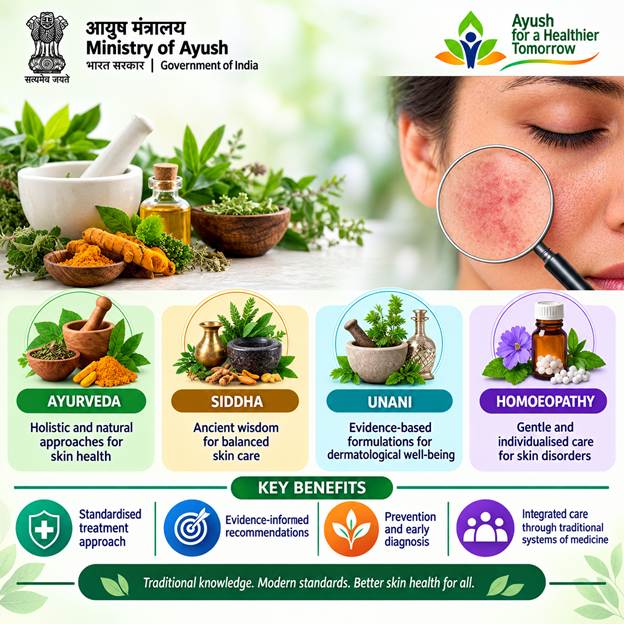

Standard Treatment Guidelines (STGs) on “Management of Dermatological Disorders for Ayurveda, Siddha, Unani and Homoeopathy”, with the inclusion of Yoga have been issued by the Ministry of Ayush. Prepared by the Ayush Vertical of the Directorate General of Health Services (DGHS), Ministry of Health & Family Welfare, the document is intended to bring more uniformity, quality assurance and evidence-informed practice to clinical care across the Ayush systems.
Shri Prataprao Jadhav, Union Minister of State (Independent Charge) for Ayush and Minister of State for Health & Family Welfare, underlined that the guidelines would deepen the integration of Ayush systems with the national healthcare framework. “These guidelines bring together system-specific clinical approaches with contemporary scientific evidence to support safe, effective and holistic care for common dermatological conditions. By promoting standardised and evidence-informed clinical practice, they will contribute to improving patient care and strengthening the role of Ayush systems in public health,” the Minister said.
Vaidya Rajesh Kotecha, Secretary, Ministry of Ayush, noted that the guidelines would help build standardisation and evidence-based clinical practice across the Ayush systems. “The Standard Treatment Guidelines for Dermatological Disorders are an important step towards strengthening standardisation, quality and evidence-based practice across the Ayush systems. Developed through expert consultations and evaluation of contemporary scientific evidence, these guidelines provide practical recommendations for prevention, diagnosis, treatment and follow-up while preserving the fundamental principles of each Ayush system. They will promote greater uniformity in clinical practice and support rational decision-making in patient care,” he said.
Dr. Loveneesh G. Krishna, Director General of Health Services, pointed to the value of multidisciplinary collaboration in improving dermatological care. “The Standard Treatment Guidelines on Dermatological Disorders are an important step towards promoting quality assurance, uniformity and evidence-based healthcare delivery across the Ayush systems. By fostering multidisciplinary collaboration, these guidelines will support Ayush practitioners in delivering safe, effective and patient-centred care,” he said.
The guidelines were made public on the occasion of the 11th Ayurveda Day. They represent a significant move towards a standardised approach to managing skin disorders through the Ayush systems. For each system, they set out specific recommendations on prevention, diagnosis, treatment, follow-up and rehabilitation for common dermatological conditions such as psoriasis, dermatitis, vitiligo, urticaria and dermatophytosis.
Interdisciplinary development
The preparation of the guidelines was a comprehensive, interdisciplinary effort. It drew on the technical expertise of the Ayush Research Councils, senior academic specialists in Ayurveda, Unani, Siddha and Homoeopathy, Yoga experts, and specialists in modern medicine. The process comprised expert consultations, a review of classical texts, an assessment of current scientific evidence and consensus-based deliberations, all while retaining the core principles of each Ayush system.
Validation in real-world settings
A notable feature of the exercise was the field-level validation of the protocols, carried out to check how well they work in actual clinical settings. The Ayush Vertical partnered with the Directorate of Ayush, Government of NCT of Delhi, to test the protocols with Medical Officers working in primary and secondary healthcare. The feedback these officers gave on the operational usability of the guidelines was built into the final documents, improving their clinical relevance and practical value.
Expected benefits
The guidelines are expected to aid rational clinical decision-making, capacity building, education and further research. They will also serve as valuable reference documents for Ayush practitioners, clinicians, academicians, researchers and policymakers. The initiative further reflects the Government’s sustained emphasis on standardisation, quality assurance and the evidence-based integration of Ayush systems into healthcare delivery.