


The Coal Controller Organisation (CCO), under the Ministry of Coal, has undertaken initiatives to promote scientific mine closure and sustainable repurposing of post-mining land.
CCO has developed SUVIKALP, an in-house Mine Repurposing Tool, to assist stakeholders in selecting suitable mine repurposing projects through a structured and data-driven decision-making process. The tool evaluates and ranks repurposing projects based on multiple technical, environmental, social and economic criteria.
Once a suitable project is identified, users can explore implementation pathways through PRISM (Post-Mining Repurposing Implementation Strategy Model). PRISM provides project concepts, implementation approaches, case studies, sample Detailed Project Reports (DPRs), tender documents and information on agencies working in similar sectors.
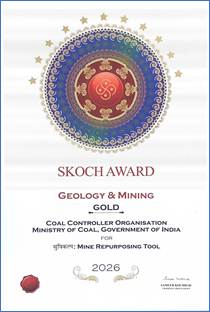
The innovation and utility of SUVIKALP received national recognition through the SKOCH Gold Award 2026 under the category “Digital Operational Efficiency – Data Driven Decision Making” on 26 September 2026. The SKOCH Awards recognise excellence in governance, technology, innovation and transformational initiatives delivering public value.
CCO has also undertaken the SUVIKALP Samvaad Webinar Series as a structured knowledge-sharing and capacity-building initiative to support informed decision-making on mine closure and sustainable repurposing. The national webinar series brought together coal companies, government officials, technical experts, academic institutions and other stakeholders to share practical solutions, innovative models and best practices related to post-mining land use.
A total of 12 thematic webinars were conducted under the series, covering the RECLAIM and L.I.V.E.S. frameworks, SUVIKALP Mine Repurposing Tool, PMU establishment, community engagement, tourism and destination development, livelihood opportunities, financing mechanisms, innovative uses of abandoned mine voids, and national and international experiences of mine transition.
The series has strengthened the institutional understanding of coal companies on the multidimensional aspects of mine closure, moving beyond regulatory compliance towards environmental restoration, livelihood generation, community development and economic diversification. Expert-led deliberations and knowledge exchange have provided practical insights and scalable approaches for planning and implementing sustainable repurposing projects.
The initiatives support the Ministry of Coal’s vision of transforming closed coal mines into productive assets and enabling sustainable regional development.