
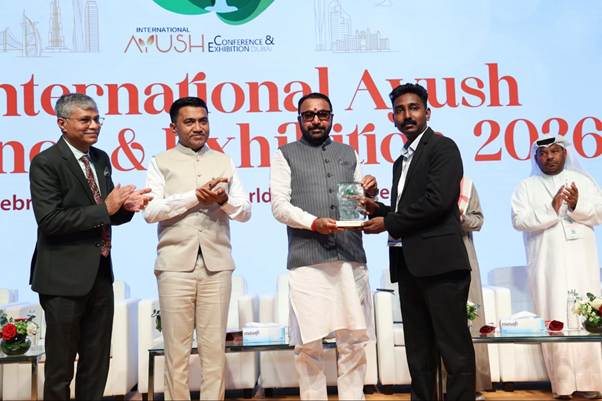

The Minister of State (Independent Charge), Ministry of Ayush, Prataprao Jadhav, inaugurated and later addressed the valedictory session of the 3rd International Ayush Conference & Exhibition (IACE 2026) held in Dubai, marking a major milestone in the global acceptance of traditional and integrative healthcare systems.
The Minister conveyed greetings on behalf of the Government of India and Prime Minister Narendra Modi, and highlighted India’s commitment to building an integrated, preventive and sustainable global health ecosystem.
Addressing international dignitaries, researchers, industry leaders and practitioners from around the world, Shri Jadhav stated that Ayush systems — Ayurveda, Yoga, Siddha, Unani and Homoeopathy — are increasingly recognised as holistic approaches addressing physical, mental and social wellbeing in harmony with nature.
He emphasised that rising lifestyle disorders, stress and mental health challenges across the world require preventive and holistic solutions, and Ayush provides evidence-supported interventions integrating body, mind and environment.
During the three-day conference, participants from nearly 28 countries engaged in consultations, scientific discussions and partnerships, demonstrating that traditional medicine is now at the centre of global healthcare dialogue.
A key outcome of the conference was detailed deliberation on a draft international White Paper on Ayush interventions for mind-body health. The document aims to transition global understanding from experience-based practice to evidence-based validation, from isolated practices to structured treatment protocols, and from parallel systems to integrated healthcare frameworks. Once finalised, it is expected to serve as a reference document for governments, academic institutions and international organisations working in integrative medicine and public health policy.
The Minister recalled that the WHO Global Summit on Traditional Medicine held in New Delhi and the Delhi Declaration reaffirmed global commitment toward evidence generation, safety standards and responsible integration of traditional medicine. He highlighted that the conference advanced this global momentum by promoting joint research programmes, academic exchanges, regulatory cooperation, investment partnerships and expansion of medical value travel and Ayush services. He further stressed the need for quality assurance, pharmacopeial compliance and international certification to enable global acceptance of Ayush products and services.
Shri Jadhav noted that such international platforms strengthen scientific dialogue, health diplomacy and trust among nations and emphasised that Ayush can act as a bridge connecting cultures and healthcare systems while supporting global health security and preventive care.
Reaffirming India’s commitment, the Minister stated that India is prepared to lead and collaborate with partner countries to build an integrated, evidence-based and human-centric global public health structure.
Declaring the conference a success, Shri Jadhav said the deliberations should translate into actionable outcomes and institutional partnerships. He expressed confidence that the discussions would strengthen scientific engagement, partnerships and the positioning of Ayush as a credible contributor to global healthcare.