
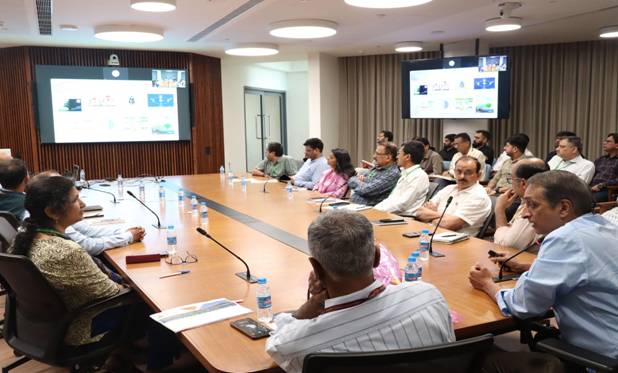

The Department of Higher Education successfully organized an interactive session on Indian Knowledge Systems (IKS) as part of Strengthening Adaptive Development and Humane Aptitude for National Advancement (Sadhana) Saptah 2026, observed from April 2nd to 8th, 2026.
The week marks the Foundation Day of the Capacity Building Commission (CBC) and the completion of five years of Mission Karmayogi, India’s landmark initiative for citizen-centric governance.
The welcome address was delivered by Joint Secretary (Administration), Department of Higher Education, Syed Ekram Rizvi, who highlighted the role of the Capacity Building Commission under Mission Karmayogi in offering a range of online courses aimed at enhancing knowledge, skills, and capacity for citizen-centric governance.
The session was designed to foster structured peer learning and meaningful deliberations on the relevance of Indian Knowledge Systems in contemporary education, research, and governance. highlighted how India’s rich intellectual traditions can inform modern approaches to problem-solving, innovation, and policymaking.
The key highlight of the event was the address by Dr. Mohan Raghavan, Associate Professor at the Department of Biomedical Engineering, IIT Hyderabad. He was the founding Head of the Department of Heritage Science & Technology and is also associated with Artificial Intelligence. Dr. Raghavan shared insights from his interdisciplinary work that bridges technology, science, and India’s knowledge traditions.
The professor highlighted that while the market potential of Indian Knowledge Systems (IKS) is significant, its true strength lies in its transformative role in higher education. He emphasized that IKS should not be viewed as a separate discipline but as a multidisciplinary framework that can enrich existing academic fields such as science, engineering, humanities, and management. By integrating IKS into higher education, universities can move beyond rote learning to a more holistic model that combines knowledge, application, and values (dharma). The professor also noted that this approach aligns with contemporary educational reforms, encouraging research, innovation, and critical thinking rooted in India’s cultural and intellectual heritage. Institutions adopting IKS can offer interdisciplinary programs, foster original research, and create graduates who are not only skilled professionals but also culturally aware and socially responsible individuals. This integration, he stressed, is essential for building a future-ready education system that is both globally competitive and deeply connected to its roots.
Interaction with the participants followed in the form of an engaging Q&A session. The session emphasized the continuing relevance of Indian Knowledge Systems in shaping holistic education and the importance of embedding traditional wisdom into governance practices for sustainable national advancement.
The session was attended by the senior officials of the Department of Higher Education, Ministry of Education. By bringing together thought leaders and practitioners, the Department of Higher Education reaffirmed its commitment to nurturing a knowledge-driven, adaptive, and humane governance ecosystem under Mission Karmayogi.