

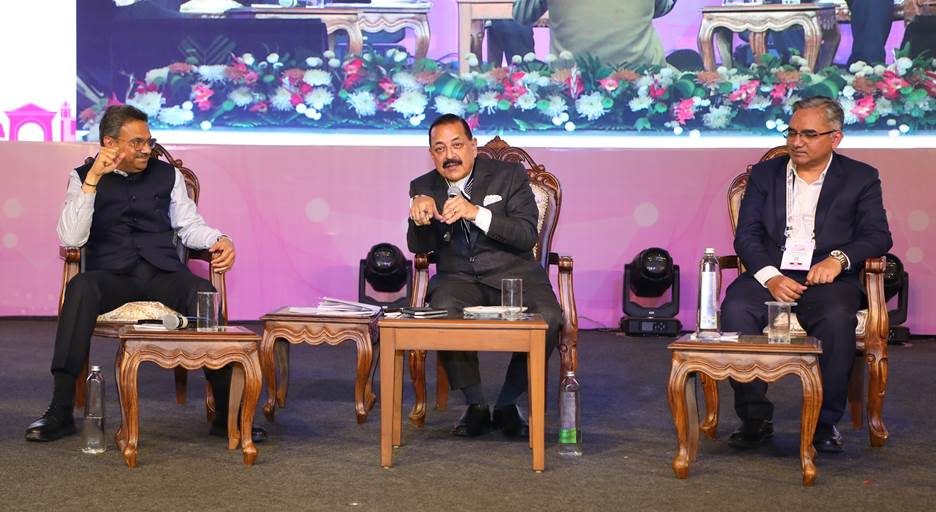

Describing StartUps as a key driver of India’s future growth, Union Minister of State (Independent Charge) for Science and Technology Dr Jitendra Singh underlined that mentorship, and not funding alone, will shape the next generation of StartUps.
The Minister emphasised the need for stronger mentorship, greater risk-taking in research and early handholding of young innovators, as he interacted with entrepreneurs and students at the India International Science Festival (IISF) here today.
Speaking during a panel discussion on “Startup Journeys” on the second day of the festival, Dr. Jitendra Singh said India had moved decisively from a situation of limited access to science education to a stage where opportunities are increasingly “democratised”, allowing talent from smaller towns and modest backgrounds to aspire for entrepreneurship. He said the government’s focus has shifted from mere policy intent to building supportive ecosystems that connect ideas to markets.
Dr. Jitendra Singh pointed out that sustained efforts under the science and technology ministries have helped create structured platforms such as BIRAC, national missions and sector-specific programmes, which link startups with funding, industry partners and mentoring. Emphasising that innovation inevitably involves failure, he said India must learn to recognise and accept risk in research and development if startups are to scale and compete globally.
The Minister highlighted how advances in science have transformed everyday life in India, citing progress in healthcare technologies and biotechnology that were once accessible only abroad. Drawing a wider parallel, he said the country today is not merely adopting global technologies but is increasingly contributing original solutions across sectors, from life sciences to digital platforms.
Responding to questions from young entrepreneurs, many of them school and college students, Dr. Jitendra Singh stressed the importance of clarity of purpose and aptitude before launching a startup. He said mentoring at an early stage was crucial to help young innovators understand their strengths, refine ideas and avoid common pitfalls. Referring to government initiatives, he noted that programmes aimed at students, particularly girls, are being expanded to identify talent early and provide structured guidance.
On regulatory concerns raised by participants, Dr. Jitendra Singh said the government has been steadily moving towards deregulation, de-licensing and decriminalisation to ease the burden on entrepreneurs. He said these reforms are intended to allow startups to focus on innovation rather than compliance, while ensuring accountability.
The panel also heard experiences from startup founders and senior administrators, including examples of technology-led solutions in healthcare and biotechnology that are reaching underserved populations. Dr. Jitendra Singh welcomed these accounts and reiterated that public-private partnership remains central to India’s innovation strategy.
Concluding his interaction, the Minister said forums like IISF are meant to bring policymakers, scientists and aspiring entrepreneurs onto a common platform. He said nurturing curiosity among children and giving them the confidence to ask questions is as important as funding or infrastructure, as India prepares its innovation ecosystem for the goals set for 2047.