
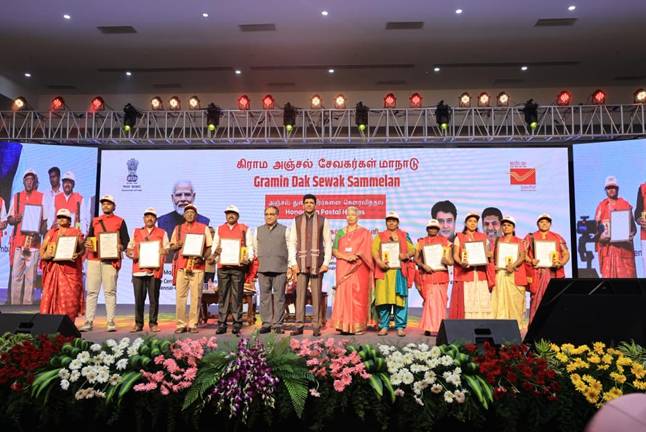

Union Minister of State for Communications Shri Chandra Sekhar Pemmasani today addressed the Gramin Dak Sevak (GDS) Sammelan in Chennai, Tamil Nadu and highlighted the historic role of India Post in connecting communities and delivering governance to the last mile.
Addressing the gathering, Dr. Pemmasani described GDS employees as the “heartbeat of rural India”, noting that they connect government services with citizens across the country.
“From letters to parcels, from government schemes to banking, from Aadhaar to passport services — you reach every village, every street and every household. Through burning sun and pouring rain, you have been a bridge of trust and a story of service for rural India,” he said while welcoming the GDS community.
Recalling the long history of organised communication systems in India, the Minister of State noted that during the Mauryan Empire, Emperor Chandragupta Maurya maintained a royal messenger service, while the Cholas, Pandyas and Cheras in the Tamil region operated extensive messenger networks across their territories. The modern postal system took shape with the establishment of the General Post Office in Calcutta in 1774, and India Post in its present form was established on 1 October 1854.
The Minister highlighted the massive opportunity emerging from India’s e-commerce growth. India Post’s parcel revenue currently stands at under ₹1,000 crore, while a single private courier company generates around ₹6,000 crore, he noted. “The logistics market today represents an opportunity of about $10 billion (₹90,000 crore) and is expected to grow to $20 billion (₹1.8 lakh crore) by 2031,” he said, urging postal employees to actively participate in capturing this opportunity.
Shri Pemmasani said that for decades India Post served as the backbone of communication across the country, carrying legal documents, money orders, newspapers and books that shaped public discourse and connected families across distances. In many rural areas, the postman often acted as a trusted intermediary by helping villagers read and write letters and serving as a link between villages and the wider world.
The Minister of State highlighted that India Post today operates one of the largest postal networks in the world, with nearly four lakh regular employees and over 2.5 lakh Gramin Dak Sevaks working through more than 1.6 lakh post offices across the country. Referring to the changing communication landscape, Shri Pemmasani said that the advent of mobile phones, the internet and private courier companies has significantly transformed the logistics sector. He stressed that the focus should be on increasing revenue and leveraging emerging opportunities rather than merely cutting costs.
Dr. Pemmasani emphasized that Gramin Dak Sevaks play a unique role in taking governance to the grassroots. “You are not the last mile of governance — you are the first mile. Without you, government services cannot reach the village,” he said. He noted that private logistics companies operate where profits exist, but India Post operates where people exist, including remote tribal areas and difficult terrain.
He also appreciated the performance of the Tamil Nadu postal circle, noting that it ranks second in the country in terms of overall revenue.
The Minister of State highlighted that under the leadership of the Prime Minister and the guidance of Union Minister for Communications Shri Jyotiraditya Scindia, the Department of Posts is transforming from a traditional service department into a large-scale, data-driven and customer-centric public logistics organisation.
He said that several initiatives are being undertaken as part of this transformation, including the appointment of senior technology and marketing leadership, regular performance reviews and enhanced focus on service delivery. A major technology upgrade is being implemented through the IT 2.0 platform with an investment of nearly ₹5,000 crore, enabling end-to-end mail and parcel tracking, SMS alerts to customers, UPI-enabled cashless transactions, geotagging and integrated digital dashboards.
Shri Pemmasani also highlighted the introduction of DigiPIN, a 10-digit geo-coded national addressing system that will support emergency response, e-commerce, drone logistics and smart governance.
The Minister of State said the Government has recognised the contribution of Gramin Dak Sevaks through revised remuneration and a structured incentive system that rewards performance, along with promotion opportunities, training programmes and transfer benefits.
Calling upon postal employees to uphold the legacy of India Post, Dr. Pemmasani urged them to deliver services with dedication and professionalism.
“Open your post office on time every day. Deliver with pride. Every savings account opened and every insurance policy issued strengthens both the department and the nation,” he said.
He also encouraged GDS employees to see themselves as contributors to India’s development journey.
“You may think you are just a postman or a GDS. But that bag you carry holds more than letters — it carries the trust of a nation,” he said, emphasising that India Post continues to play a vital role in connecting the country and supporting the vision of Viksit Bharat.