

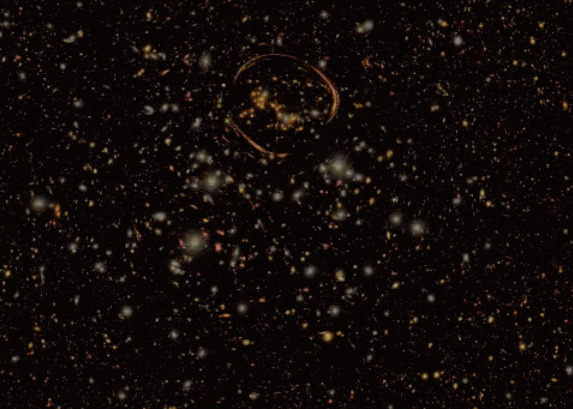

The broadest planned survey by the Nancy Grace Roman Space Telescope, the High-Latitude Wide-Area Survey, will reveal hundreds of millions of galaxies scattered across the cosmos. After Roman launches, scientists will use these sparkly beacons to study the universe’s shadowy underpinnings: dark matter and dark energy.
The survey will combine the powers of imaging and spectroscopy to unveil a goldmine of galaxies strewn across cosmic time. Astronomers will use the survey’s data to explore invisible dark matter, detectable only via its gravitational effects on other objects, and the nature of dark energy—a pressure that seems to be speeding up the universe’s expansion.
The Light Around a Dying Star
The Hubble Space Telescope has revealed the clearest view yet of the Egg Nebula—the first, youngest, and closest pre-planetary nebula ever discovered. Located approximately 1,000 light-years away in the constellation Cygnus, the Egg Nebula features a central star obscured by a dense cloud of dust—like a “yolk” nestled within a dark, opaque “egg white.”