
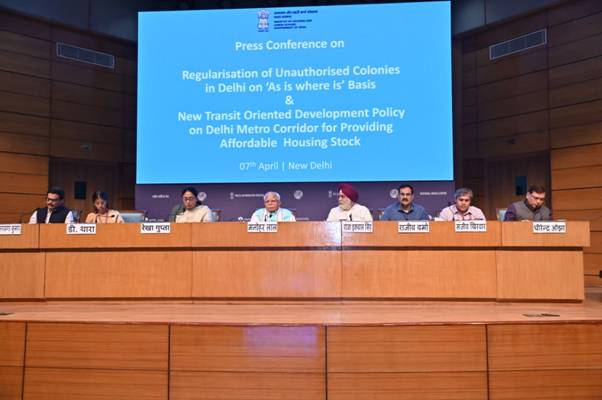

Union Minister for Housing and Urban Affairs Shri Manohar Lal during a press conference in New Delhi said that the Transit Oriented Development (TOD) concept has already been envisaged in the Master Plan of Delhi 2021 and the Regulations for Transit Oriented Development (TOD) and Charges, 2026 builds upon this vision to promote planned, sustainable, and transit-linked urban growth, particularly along metro corridors, thereby enhancing accessibility and enabling the creation of affordable housing stock.
Union Minister Shri Manohar Lal also said that these transformative steps have been undertaken under the guidance and inspiration of Prime Minister Narendra Modi. He stated that under the leadership of the Prime Minister, Delhi is witnessing a new phase of planned and inclusive urban development, aimed at addressing legacy issues while building a future-ready city.
Smt. Rekha Gupta stated that, in line with the visionary thinking of the Hon’ble Prime Minister, efforts are being made to further strengthen the future of Delhi. She highlighted that under the Transit Oriented Development (TOD) policy, planned, high-density, and mixed-use development will be promoted within a 500-metre radius around Metro and RRTS corridors, covering an area of approximately 207 square kilometres.
She added that this will pave the way for affordable housing, improved connectivity, and ease of living. The initiative will serve as a significant support, particularly for poor and middle-class families.
The new Policy ensures provisioning of affordable housing in NCT of Delhi and sustainable mobility & optimised utilisation of land through compact mixed-use development, by leveraging existing and upcoming public transit infrastructure and associated large number of users.
The current policy has a corridor based approach and opens up an area of 207sq.km (500m on either side of Metro corridors and 500 m radius of RRTS/Railway Stations etc.) primarily for provisioning of affordable housing through planned development and redevelopment.
Out of this 207 Sq. Km, about 80 sq. Km of an area under Land Pooling, Low Density Residential Area and Unauthorised Colonies, which was excluded in the earlier TOD Policy, has now been brought under the purview of new TOD Policy.
Policy provides flexibility and allows for TOD development along the operational as well as proposed metro corridors/ RRTS/Railway Stations etc. This will allow TOD development to commensurate with the construction of the new metro corridors. New affordable housing and related infrastructure can come up in a planned way in such areas. This will also ensure enhanced metro ridership and better livability.
The Policy enables development of smaller size plots of 2000 sq.m. under TOD provisions.
Maximum FAR upto 500, is permitted in TOD Zones on plot size of 2000 sq.m. and above, with 18 m road. Out of this 65 % of total permissible FAR has been mandatorily earmarked for Residential use with Dwelling Units with built-up area of 100 Sq.m (≤ 99 Sq. m.) thereby providing for affordable housing along the metro corridor.
The policy envisages a high density, mixed use planned development specifically aiming at creation of affordable housing along all metro corridors.
Out of the remaining 35% of FAR, 10%to be used for provision of commercial & amenities for the housing area. There is a flexibility in usage of 25% of FAR which can be used for bigger size housing, Office Space, Guest House and Studio Apartments.
For convenience and enhanced walkability of the residents in the TOD plots, new underground/ elevated pedestrian walkways can be provided for connecting to the transit/metro stations.
Public & Semi-Public Facilities shall get augmented though enhanced FAR in Public & Semi-Public plots falling in TOD Zone.
The Policy has removed existing inefficiencies in the earlier policy and promotes Ease of Doing Business (EoDB) in terms of the following:
Node based approach requiring a minimum 8 Ha of developable land for declaration of a TOD Node has been replaced by corridor based approach. Further, the corridor can be an operational or a proposed one.
Earlier policy required a minimum plot area of 1 Ha. Maximum FAR up to 500 was only allowed on plots having minimum area of 4 Ha located on 30 m road. Now this is allowed on smaller size plots of 2000 sqm with 18m road.
Mix of use based on the landuse of the TOD plots has been removed in the current Policy.
Earlier Policy required preparation of Influence Zone Plans (IZPs) for each of the TOD Node prior to approval of TOD Projects. TOD projects were then required to be sanctioned by the Local Bodies. This has now been replaced by single window system to promote EoDB.
Under the earlier Policy DE has to pay various Charges to DDA/ Local Body such as TOD Charges, Additional FAR Charges (for FAR over and above the permissible FAR), Conversion charges for lease hold to free hold. This has been replaced by simplified and single TOD charge under the current Policy.
Policy promotes Ease of Doing Business (EoDB) through single window application & clearance with simplified mechanism for approval of TOD projects. TOD Committee under VC, DDA comprising of all concerned stake holders including service providing agencies to ensure time bound and seamless approval of TOD projects. The citizen(s) requiring to develop their land shall be required to apply for approvals along with the charges at one point only, without requiring to separately approach any of the service providing agencies such as MCD, DJB, DFS etc. The policy provides for time bound approvals.
TOD Charges have been simplified and single TOD charge has been proposed under this Policy (encompassing charges for water & sewerage of DJB, sanction charges of MCD including charges for landuse change and levy/additional levy/ additional FAR and DDA charges for conversion from lease hold to freehold).