

On a crisp December morning at Delhi’s Sunder Nursery, the lawns were alive with the hum of a crowd eager to taste India’s finest regional dishes. But at one stall near the entrance, something else was drawing people in, an infectious confidence, the kind that radiates from someone who knows she has changed not just her own life, but the lives of hundreds of others. Behind the counter stood Mrs. Vandana Bharadwaj from Mohali, Punjab, arranging her Phulkari fabrics with practiced ease. The vibrant embroidery shimmered under the winter sun, but it was her journey that sparkled brighter. She began her journey in 2018 as one of ten women in a small SHG, stitching Phulkari at home while managing household responsibilities. Her leadership soon stood out. First, she headed 19 SHGs in her village organisation and later as the anchor for a growing network of women who trusted her guidance. Today, Vandana leads over 500 Self-Help Groups (SHGs) across 25 villages, a community enterprise larger than many formal institutions. Her stall at the Saras Food Festival 2025 showcased not just handcrafted products but also the collective progress and empowerment of women.
Vandana didi explains, “The government supported us at every step.” We received sewing machines and Rs. 30,000 as working capital from the Ministry of Rural Development. These interventions helped us transform Phulkari stitching into a real enterprise. Under her leadership, rural women now produce a diverse range of items, including sweaters, school uniforms, and especially high-quality Phulkari fabrics. Their craftsmanship is so refined that government departments purchase their phulkari products to present to national and foreign dignitaries. The government also procures its goods to export to other countries
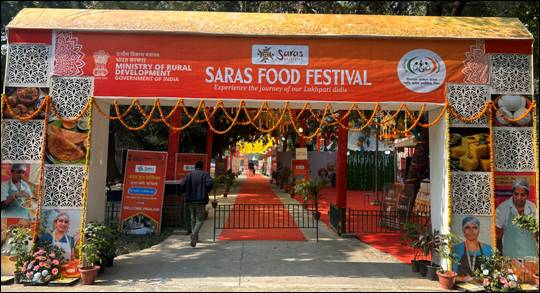
Across Sunder Nursery, the same spirit reverberated through every lane of the Saras Food Festival 2025. Nearly 300 Lakhpati Didis and SHG entrepreneurs from 25 states had arrived, bringing more than 500 dishes and dozens of handcrafted products, transforming Delhi into a living map of India. The air carried the scent of dal baati churma, Malabar biryani, Himachali siddu, and tandoor tea, but behind each aroma was a woman with a story as layered as her recipe.