
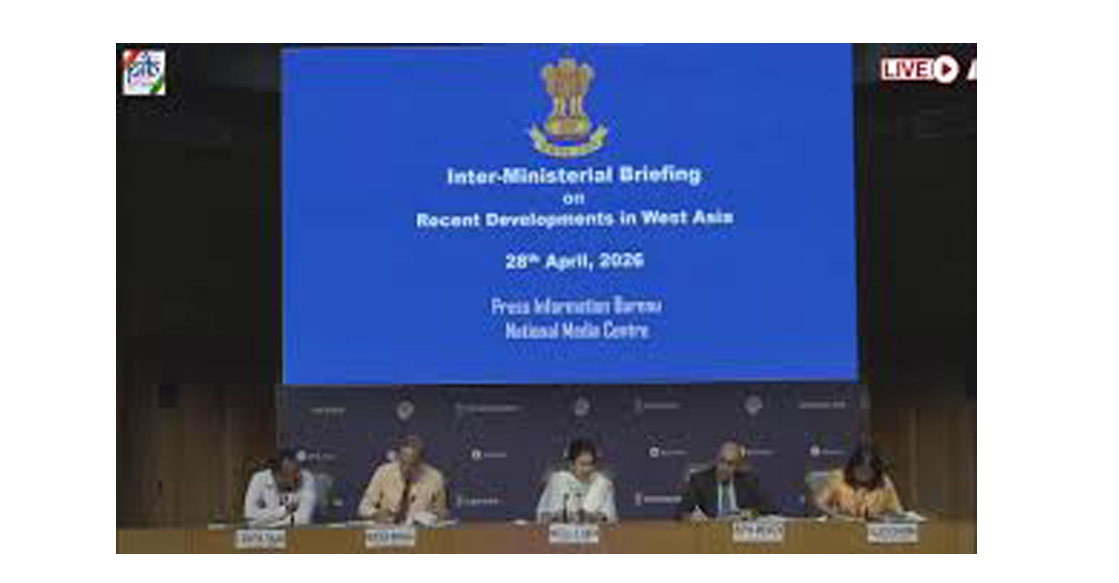

Amid the evolving situation in West Asia, the Government of India continues its efforts to keep citizens informed through regular updates. In this regard, a media briefing was held today at the National Media Centre, where officers from the Ministries of Petroleum and Natural Gas, Ports, Shipping and Waterways, and External Affairs provided updates on fuel availability, maritime operations, assistance to Indian nationals in the region, and measures being undertaken to maintain stability across key sectors. The Ministry of Textiles also shared updates regarding the textiles sector.
Textiles and handicraft sector updates
Ministry of Textiles has been in regular touch with stakeholders on the issues faced by the textiles and handicraft sector due to the West Asia crisis. A monitoring cell has been formed which is looking at measures that the Ministry can take to facilitate the industry. Some of the actions taken in response to the crisis are the following:
Regular Stakeholder consultations
The Ministry is holding periodic meetings with stakeholders on a weekly basis for monitoring the situation. These include meetings with Export Promotion Councils (EPCs), Domestic Associations, regional cluster associations (Tirupur, Surat, Pali Balotra), state government officials. The Ministry is also in touch with the office of DG Shipping, GAIL and other agencies. The Ministry also organized an outreach programme on the Resilience & Logistics Intervention for Export Facilitation (RELIEF) Scheme of the Department of Commerce.
Moreover, EPCs also organized their independent consultations. The Carpet Export Promotion Council (CEPC) organized a webinar on 6 April, 2026 on the RELIEF Measures. Export Promotion Council for Handicraft (EPCH) organized an awareness seminars on 20 April, 2026 on logistics challenges in the wake of the West Asia crisis. The discussions centered around global shipping disruptions, alternative routing, , logistics planning, cost optimization techniques and compliance issues.
The advisories issued by DG Shipping are being circulated among the stakeholders. Some of the issues related to shipping lines such as use of alternate ports like Jeddah for supplies to West Asia are also being disseminated to stakeholders.
Ensuring supplies of fuel/natural gas for the industry
Ministry Of Textiles had taken up the issue with Ministry of Petroleum and Natural Gas (PNG) for supply of natural gas to the textiles and handicraft industry. In response, GAIL indicated that textiles and handicraft sector are under the Priority Sector III/IV (industrial consumers) with supplies maintained at 80% of the past 6 months’ average consumption. In case of supply disruptions, GAIL is intermittently sourcing supplies from the spot market.
The Ministry is monitoring the supply in the clusters. In case of any shortfall, the monitoring cell would take up the issue with GAIL authorities for spot market purchases.
Removal of customs duty on inputs for the textiles and handicraft sector
In the light of the price volatility and the need to ensure supply chain continuity for the downstream industry, the Ministry has been advocating the removal of customs duty on inputs in the textiles and handicraft sector.
In this context, the Department of Revenue in its Customs Notification 12/2026 dated 1.4.26 removed customs duty on a number of products including inputs in the MMF sector. In the case of textiles sector, duties were deferred on 29 inputs including Monoethylene Glycol (MEG), Purified Terephthalic Acid (PTA), Poly(ethylene terephthalate) (PET) chips, Poly(butylene terephthalate) (PBT), Methanol, Toluene, Styrene, Vinyl Chloride Monomer (VCM), Phenol, Acetic Acid, Vinyl Acetate Monomer (VAM), Ethylenediamine, Monoethanolamine/ Diethanolamine, Polyethylene (PE), Polypropylene (PP), Polystyrene (PS), Polyvinyl Chloride (PVC), Acrylonitrile-butadiene-styrene (ABS), Styrene-acrylonitrile (SAN), Polyvinyl Acetate (PVA), Polyvinyl alcohol, Epoxy resins, Polyurethanes, Polycarbonates, Alkyd resins, Unsaturated polyester resins, Toluene di-isocyanate (TDI), Polyols, and Linear Alkylbenzenes.
Secondly, the Ministry has also taken up the issue of removal of customs duty with Department of Revenue on some of the other inputs namely:
MMF value chain:
Caprolactam
Nylon chips
Rayon Grade Wood Pulp
Cotton
Inputs for glassware manufacture namely Soda Ash (Sodium Carbonate) (HS 283620), Boric acid/ Boron oxide (HS 281000), Alumina (HS 281820), selenium compounds (HS 280490), cerium oxide (HS 284610), Zirconia refractories (HS 690390), Furnace burners/ systems (HS 841620, 841780), potassium nitrate (HS 283421), potassium carbonate (HS 283640), arsenic trioxide (HS 281129) and barium carbonate (HS 283660)
Removal/ Deferment of Anti-Dumping duty
Some of the downstream producers have also indicated that the anti-dumping duty on some of their inputs would adversely affect their sourcing in the light of the volatile prices. After undertaking an internal analysis taking into account the employment generated in the downstream sector, MSME participation in the downstream sector, supply chain disruptions etc the Ministry of Textiles has also suggested to the Department of Revenue for removal/deferment of anti-dumping duty on the following:
Elastomeric Filament Yarn (EFY)
Viscose Rayon Filament Yarn (VFY)
Dissemination of information on Best Practices of State Governments
In the meeting with State Governments and cluster associations, some of the best practices adopted by States were disseminated to stakeholders. Some of these included
District Level Committee under the Chairmanship of DM/DC for reviewing the LPG distribution
Encouraging MSME units to transit to piped natural gas (PNG)
Opening of community kitchens for blue collar workers
Use of alternate fuel like torrefied biomass from cotton stalk, instead of coal.
Export Remission Schemes
Some of the suggestions from stakeholders were on the Export remission schemes relating to the textiles sector. These schemes include the Remission of Duties and Taxes on Exported Products (RODTEP) and Rebate of State and Central Taxes and Levies (ROSCTL).
The suggestions include the increase of rates, restoration of rates for the period when they were reduced and enhancing the coverage of the scheme. These have been examined and taken up with the appropriate authorities.
Proposals related to Foreign Trade Policy (FTP)/ Export Promotion Mission (EPM)
During the stakeholder consultations, some of the proposals related to FTP/ EPM. These include proposals on interest subvention, Export Promotion Capital Goods (EPCG) Scheme, Advance Authorisation (AA), etc. All the suggestions relate to facilitate exporters during the West Asia crisis. The matter has been examined internally and proposals sent to office of DGFT
Energy Supply and Fuel Availability
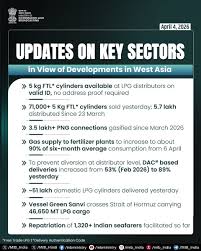
The Ministry of Petroleum and Natural Gas provided an update on the current fuel supply situation, outlining measures being taken to ensure uninterrupted availability of petroleum products and LPG in the context of the evolving situation in West Asia. It was noted that:
Public Advisory and Citizen Awareness
Citizens are advised to avoid panic purchase of petrol, diesel and LPG as the Govt is making all efforts to ensure availability of petrol, diesel and LPG.
Beware of rumours and rely on official sources for correct information.
LPG consumers are requested to use digital booking platforms and avoid visiting distributors.
Citizens are encouraged to use alternate fuels such as PNG and electric or induction cooktops.
All citizens are requested to make necessary efforts to conserve energy in their daily use during the current situation.
Government Preparedness and Supply Management Measures
Despite the ongoing geopolitical situation, the Government has ensured that 100% supply is being made to Domestic LPG, Domestic PNG and CNG (Transport).
For commercial LPG, priority has been given to hospitals, educational institutions. Besides this, priority has also been given to pharma, steel, automobile, seed, agriculture, etc. In addition to this, supply of 5 Kg FTL to migrant labour is also doubled based on avg. daily supply on 2nd and 3rd March 2026.
The Government has already implemented several rationalisation measures on both the supply and demand side, including enhancing refinery production, increasing the booking interval from 21 to 25 days in urban areas and up to 45 days in rural areas and prioritising sectors for supply.
Alternate fuels such as kerosene and coal have been made available to ease pressure on LPG demand.
The Ministry of Coal has directed Coal India and Singareni Collieries to supply additional coal to States for distribution to small and medium consumers.
States have been advised to facilitate new PNG connections for domestic and commercial consumers.
Coordinated Efforts with States/UTs and Institutional Mechanisms
State Governments are empowered under the Essential Commodities Act, 1955 and LPG Control Order, 2000 to monitor supply and act against hoarding and black marketing.
Govt. of States/UTs have to play a primary role in monitoring and regulating supply situation of essential commodities including Petrol, Diesel and LPG. Govt. of India has reiterated the same via multiple letters and VCs to all States/UTs.
The Government of India vide letters dated 27.03.2026 and 02.04.2026 have stressed the need for proactive public communication to reassure citizens regarding adequate fuel availability. Regular review meetings are being held with States/UTs. In this context, meetings were convened on 02.04.2026 (Chaired by Secretary, MoPNG) and on 06.04.2026 (Chaired by Secretary, MoPNG along with Secretaries of I&B and Consumer Affairs), wherein the following was emphasized:
To issue daily press briefings and issue regular public advisories.
To actively monitor and counter fake news / misinformation on social media.
To intensify daily enforcement drives by District admin and to continue raids and inspections in coordination with OMCs
To issue Commercial LPG allocation orders within their States/UTs
To issue SKO allocation orders for additional SKO allotted to the States/UTs.
To promote PNG adoptions and alternate fuels.
To prioritize LPG supply, especially for domestic needs, and adopt targeted distribution of 5 kg FTL cylinders to ensure supply stability.
All States/UTs have established control rooms and district monitoring committees to curb hoarding and black marketing.
Many states/UTs are issuing/carrying out press briefs.
Enforcement and Monitoring Actions
Enforcement actions continue across the country to curb hoarding and black marketing of LPG. Yesterday, more than 2800 raids were conducted across the country.
Since March 2026, more than 67,000 cylinders have been seized in multiple raids across the country. Further, more than 1160 FIRs have been registered, and 271 persons have been arrested.
PSU OMCs have strengthened and continued surprise inspections and imposed penalties on 316 LPG distributorships, and 72 LPG distributorships have been suspended till yesterday.
Yesterday, show cause notices were issued to 46 LPG distributors, penalties were imposed on 6 distributorships, and 1 distributor was put under suspension.
LPG Supply
Domestic LPG Supply Status:
LPG supply continues to be affected by the prevailing geopolitical situation.
Supply of LPG to domestic households has been prioritized.
No dry-outs have been reported at LPG distributorships.
Online LPG cylinder bookings increased to 99% on industry basis yesterday.
Delivery Authentication Code (DAC) based deliveries have increased to around 93% to prevent diversion. DAC is received on the registered mobile number of the consumer.