

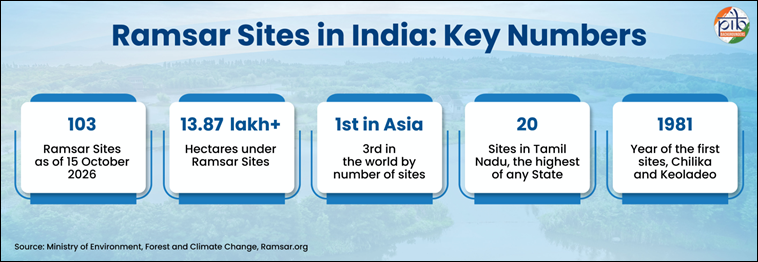

India’s network of Wetlands of International Importance under the Ramsar Convention has expanded nearly fourfold since 2014. It has grown from 26 to 103 designated sites covering over 13.87 lakh hectares. Ranking first in Asia and third globally, these ecosystems safeguard biodiversity, buffer floods, recharge groundwater, and sustain livelihoods. Anchored by the Wetlands (Conservation and Management) Rules, 2017, the Government of India drives scientific and participatory conservation through the National Plan for Conservation of Aquatic Ecosystems (NPCA), Amrit Dharohar, MISHTI, and Mission Sahbhagita to secure long-term ecological resilience.
Ramsar Sites in India — At a Glance
As per the Ramsar Convention, “Wetlands are the areas of marsh, fen, peatland or water, whether natural or artificial, permanent or temporary, with water that is static or flowing, fresh, brackish or salt, including areas of marine water the depth of which at low tide does not exceed six metres”. Linking land and water, wetlands store fresh water, recharge groundwater, buffer floods and sustain fisheries and farming. They also shelter migratory birds and rich biodiversity, placing them among the most productive ecosystems on Earth.
Globally, these habitats are protected under the Convention on Wetlands or the Ramsar Convention, an intergovernmental treaty. It was adopted at Ramsar, Iran, on 2 February 1971 and entered into force in 1975. As on October 2026, it now includes 172 Contracting Parties and over 2,536 designated “Ramsar Sites” worldwide.
India, home to a large number of wetlands, became a Party to the Convention on 1 February 1982. It has steadily expanded its network since then. The country now has 103 Ramsar Sites, a nearly fourfold rise from just 26 sites in 2014. India’s network ranks first in Asia and third in the world in terms of number of sites. Collectively, these sites cover more than 13.87 lakh hectares across 28 States and Union Territories.
Understanding Ramsar Sites
A Ramsar Site is a wetland designated as a Wetland of International Importance under the Ramsar Convention. These sites are recognised for their ecological, botanical, zoological, limnological or hydrological significance. The Ramsar Convention rests on three pillars. These are the wise use of all wetlands, the designation and effective management of Ramsar Sites, and international cooperation on wetland conservation.
How a Wetland is Designated
In India, the process begins with the State Government or Union Territory Administration identifying a suitable wetland. The Ministry of Environment, Forest and Climate Change then coordinates approval and forwards the proposal to the Ramsar Secretariat.