
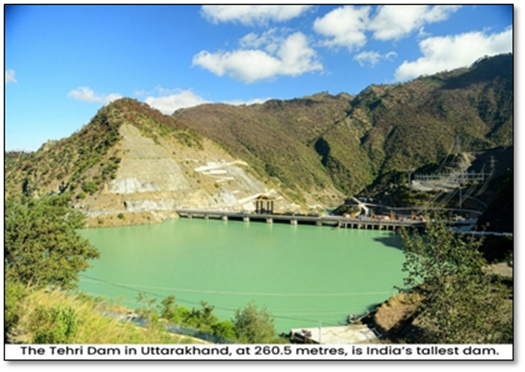

India’s dams play a critical role in irrigation, hydropower generation, flood moderation, drinking water supply and overall water security. Over the decades, dams have contributed significantly to agricultural growth, industrial development and socio-economic progress across the country.
As a large number of dams age and climatic variability increases, the issue of their rehabilitation, operational safety and long-term resilience becomes important. The Government of India addresses this through a comprehensive approach combining structural rehabilitation, institutional reforms, digital monitoring systems and risk-based safety management.
India today manages one of the largest dam portfolios globally. It ranks third in the world, with 6628 specified dams, of which 6,545 are operational and 83 are under construction. The gross water storage capacity of these dams is about 330 billion cubic metres. They are critical for ensuring national food, energy, and water security.
About 26% (1,681 dams) of these dams are more than 50 years old. This includes 291 that are more than 100 years old. About 42% fall within the 25–50 years age bracket. India’s oldest, the Kallanai (Grand Anicut) in Tamil Nadu, has functioned for nearly 2,000 years—showcasing enduring engineering and maintenance.
Around 98.5% of these dams, which comes to 6,448, are owned by State Governments. Central Public Sector Undertakings have 49 dams or 0.7%; private entities own 0.6% or 36 dams, and the Central Government owns 0.2% or 12 dams. Maharashtra has the highest number of specified dams, followed by Madhya Pradesh, Gujarat, Chhattisgarh, Rajasthan, Karnataka and Odisha.
Ageing infrastructure, sedimentation, changing hydrological patterns and increasing climate variability have highlighted the need for systematic rehabilitation and safety management. Analysis of 439 reservoirs in India (CWC data) shows an average 19% loss of gross storage capacity with an average reservoir age of 42 years. The average annual loss of storage is estimated at 0.74%, equivalent to about 1.81 MCM per reservoir per year.