

Union Minister of State (Independent Charge) for Science & Technology, Earth Sciences, PMO, Personnel, Public Grievances, Pensions, Atomic Energy and Space, Dr. Jitendra Singh said that fast evolving realm of governance calls for rapid adaptiveness , and the ability to continuously learn for effective public administration, as knowledge acquired today can quickly lose relevance in the face of technological advancements. He said, this transformation is crucial for achieving India’s vision of becoming a developed nation by 2047.
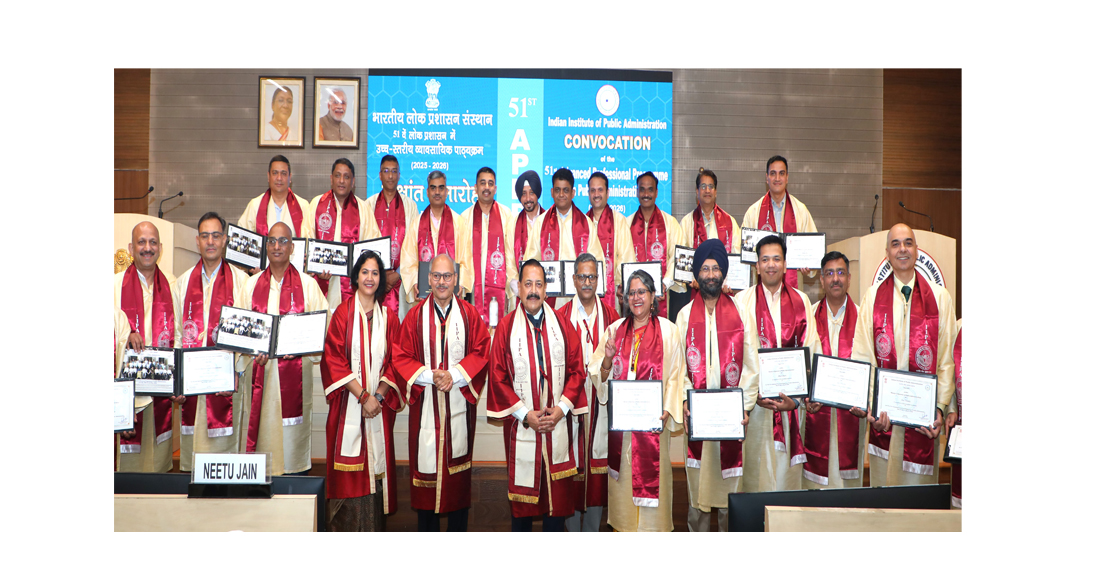
Dr. Jitendra Singh was addressing the Convocation Ceremony of the 51st Advanced Professional Programme in Public Administration (APPPA) at the Indian Institute of Public Administration (IIPA). The programme, instituted in 1975, is a flagship capacity-building initiative of IIPA leading to a Master’s degree in Public Administration and Public Policy in collaboration with Panjab University, Chandigarh.
The event was attended by Director General, IIPA Dr. Pargade, Professor Surbhi Pandey, Dr. Sachin Chaudhary, Professor Ravi Saklani and senior officers from All India and Central Services, including participants from the armed forces and other sectors.
Emphasising the changing nature of governance, Dr. Jitendra Singh said that administration today is increasingly technology-driven, while citizen expectations are on the rise. He said public administration must respond not only through structural reforms but also through a continuous reorientation of mindset among officers to deal with unpredictable and dynamic challenges.
Referring to the evolving governance paradigm, the Minister said the focus has shifted from “Government” to “Governance” and further towards “Minimum Government, Maximum Governance”, with greater emphasis on transparency, accountability and citizen-centric service delivery.
Highlighting the role of capacity building, the Minister said the APPPA programme has, over the decades, contributed significantly in equipping senior officers with both domain knowledge and practical skills required for policy implementation. He said the programme aligns with Mission Karmayogi, which seeks to build competencies among civil servants for responsive and future-ready governance in the Amrit Kaal.
Dr. Jitendra Singh stressed that training programmes must evolve in line with emerging needs and suggested greater use of interactive and feedback-driven approaches, including anonymous feedback mechanisms, to better align course design with the expectations of participating officers.
The Minister also pointed to the growing importance of effective communication, in present times, as a key administrative skill, noting that modern governance requires officers to engage effectively with citizens, media and multiple stakeholders in an increasingly connected environment.
Referring to governance innovations such as the Aspirational Districts Programme, he said the competitive, data-driven model has demonstrated measurable improvements across sectors and is now moving towards a more technology-integrated next phase, further strengthening outcome-based governance.
Dr. Jitendra Singh noted that since its inception, the APPPA programme has trained over 1,700 officers from All India and Central Services, including participants from the armed forces, state services and even foreign countries, many of whom have gone on to hold key positions in government.
Congratulating the participants, faculty and organisers, he said that programmes like APPPA not only enhance administrative capacity but also prepare officers to contribute meaningfully to nation-building in an increasingly complex governance environment.