
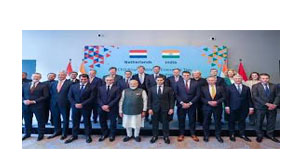

At the invitation of the Prime Minister of the Netherlands, Mr. Rob Jetten, Prime Minister Shri Narendra Modi paid an official visit to the Netherlands on 16-17 May 2026. This marked Prime Minister Modi’s second visit to Netherlands.
In the morning of May 16, Prime Minister Modi was hosted by Their Majesties King Willem Alexander and Queen Maxima of the Netherlands at the Royal Palace Huis ten Bosch in the Hague for a bilateral meeting. Their Majesties also hosted a luncheon for Prime Minister Modi.
Prime Minister Jetten and Prime Minister Modi met for restricted and delegation level talks, followed by a dinner in the evening of May 16. Both Prime Ministers recalled the longstanding and historical trade linkages, deep rooted people-to-people ties and robust bilateral relations between the two countries and expressed their desire for further expanding and deepening this multifaceted relationship. In this context, the two leaders noted with satisfaction the progress achieved in recent years across various cooperation programmes through regular interactions, including at the highest political level and through the fruitful collaboration during India’s Presidency of the G20 in 2023 and the AI Impact Summit in New Delhi in February 2026.
Acknowledging the strong momentum in the relationship and the growing convergences between the two countries, the two leaders decided to elevate the relations between India and the Netherlands to a ‘Strategic Partnership’. In this context, they welcomed the adoption of a Strategic Partnership Roadmap under which both sides agreed to work through regular and structured cooperation in all areas, including political, trade and investment, defence & security cooperation, cyber security, critical & emerging technologies including semiconductors, space, AI & quantum system, science & innovation, sustainability, health, sustainable agriculture and food systems, water management, climate change and energy transition, sustainable transport, maritime development, education, culture and people-to-people ties. The two sides also agreed to explore exchanges in the domain of policy planning.
Both leaders welcomed in this regard the agreements concluded in December 2025 across different priority sectors, such as on defence, semiconductors and related emerging technologies, enhanced cooperation in digital and cyberspace, collaboration in pharmaceuticals and medical devices, the establishment of a Joint Trade and Investment Committee, as well as the cooperation between the maritime museums in Lothal and Amsterdam.
The two leaders noted the Pact for the Future and reaffirmed their commitment to upholding shared values and principles including democracy, human rights, international peace and security, and a rules-based international order in line with the purposes and principles of the UN Charter. Both governments also underscored their commitment to strengthen and reform the multilateral system including expansion of both permanent and non-permanent categories of membership of the UN Security Council to reflect contemporary realities and called for text-based negotiations within a fixed timeframe. Prime Minister Modi thanked Prime Minister Jetten for the continued Dutch support to India’s permanent membership of a reformed and expanded UN Security Council.
Both leaders reaffirmed their commitment to further deepen the India-EU Strategic Partnership and welcomed in this regard the conclusion of negotiations for a mutually beneficial India-EU Free Trade Agreement in January this year. They agreed that the free trade agreement will strengthen political and economic ties between the world’s second and fourth largest economies, at a time of rising geopolitical tensions and global economic challenges and highlight the joint commitment to economic openness and rules-based trade. The two leaders further welcomed the simultaneous signing of the Security and Defence partnership that will strengthen EU and India’s dialogue and cooperation on security and defence, and deliver concrete results in areas such as maritime security, cyber, counterterrorism and defence industrial collaboration.
The leaders agreed on the importance of a free, open, secure and peaceful lndo-Pacific, based on respect for international law, sovereignty and territorial integrity, freedom of navigation, and absence of coercion and conflicts. Recalling the EU Strategy on the Indo-Pacific, Prime Minister Jetten announced the decision of the Netherlands to join the Indo-Pacific Oceans Initiative (IPOI) and co-lead the Capacity Building & Resource Sharing pillar along with Germany and the European Union.
On Ukraine, the two sides expressed concern over the ongoing war, which continues to cause immense human suffering and carries global consequences. Both leaders agreed to continue to support efforts towards the achievement of a comprehensive, just, and lasting peace in Ukraine through dialogue and diplomacy, based on the principles of the UN Charter and international law.
Both leaders expressed deep concern over the situation in West Asia / the Middle East, noting its serious implications for the region and the wider world, including immense human suffering and disruptions to global energy supplies and trade networks. The leaders welcomed the ceasefire announced on 08 April 2026. They underscored the importance of de-escalation, dialogue and diplomacy and expressed hope for lasting peace in West Asia / the Middle East. They also called for freedom of navigation and global flow of commerce through the Strait of Hormuz, while opposing any restrictive measures, and reaffirmed their support for ongoing efforts and initiatives in this regard.
Economic Cooperation, Trade & Investment
Both leaders noted that the Netherlands–India economic partnership stands out as a model of cooperation, driven by shared priorities such as sustainability, innovation, and long-term growth, creating mutual prosperity for both nations. They welcomed the growth in bilateral trade between the two countries, supported by efficient supply chains and shared commitment to open markets. The Netherlands, with its world class logistics network also serves as a strategic gateway to Europe for Indian exporters, including via its Port of Rotterdam whilst India offers a vast and dynamic market for Dutch companies who will also benefit significantly from upscaling opportunities, its business friendly environment, and the availability of a vast and skilled talent pool in India. At the same time, Indian businesses can leverage advanced Dutch expertise, particularly in water management, sustainable agriculture, and smart cities.
Expressing satisfaction with the existing economic collaboration between the two countries, the leaders emphasized the immense potential for further growth particularly in light of opportunities arising from the India-EU Free Trade Agreement. The Netherlands continues to remain one of India’s major trade and investment partners, reflecting the depth and resilience of the bilateral economic ties.
In order to further facilitate trade and investment, the Prime Ministers welcomed the signing of the Agreement on Mutual Administrative Assistance in Customs Matters, enabling the exchange of information between the customs authorities of the countries and thus contributing to enhanced customs enforcement and the facilitation of legitimate trade between India and the Netherlands.
The leaders reaffirmed their commitment to further advancing bilateral trade and investment through, amongst others, the India–Netherlands Joint Trade and Investment Committee and the Fast Track Mechanism. They agreed to focus on enhancing investment facilitation and strengthening innovation ecosystems to support sustainable growth, job creation and resilient value chains.
Both Prime Ministers underscored the strong potential for cooperation in startups and innovation, noting that solutions developed in India and the Netherlands can scale globally, including across Indian and EU markets. They agreed to further connect both countries’ startup ecosystems, facilitate exchanges, and explore digital soft-landing programmes, as well as increased participation in trade missions, innovation missions and technology summits.
Defence & Security Cooperation
Both leaders welcomed the signing of the Letter of Intent on Defence Cooperation and emphasized the importance of deepening of the defence cooperation between the two countries including through regular interaction between respective Ministries of Defence and staff level talks, to coordinate exchanges of information, visits, research, innovation and training activities. They also concurred to move towards further expanding the scope of Defence Industrial Cooperation between the two countries.
Both leaders also agreed to enhance cooperation in the defence sector, under EU mechanisms and with other partners, and will explore possibilities of establishing a Defense Industrial Roadmap in which defence industrial collaboration for manufacturing of defence equipment, systems, components and other key capabilities through co-development, transfer of technology and setting up of joint ventures for co-production towards meeting the needs of the Armed Forces of both countries are laid down.
The leaders agreed to further enhance the security co-operation, including through regular exchanges between the National Security Apparatus of both countries on traditional and non-traditional security issues, including defence, maritime security, economic security, critical and emerging technologies, cyber security, counter terrorism and other mutually agreed matters of international security.
Both leaders expressed satisfaction with the annual bilateral cyber consultations as well as noted the holding of 8th session of the online cyber school, as means to further strengthen cooperation between the two countries to ensure an open, free and secure cyberspace. In this context, the leaders welcomed the signing of the Letter of Intent on enhanced collaboration in cyberspace, including closer coordination in multilateral fora and joint efforts on countering cyber threats and cybercrime through capacity building and the exchange of knowledge.
Both leaders underlined the importance of an open, free, secure, stable, accessible and peaceful ICT environment, which is seen as an enabler for innovation and economic growth and innovation. In this regard Prime Minister Modi thanked the Netherlands for its constructive participation in the AI Impact Summit that took place on 19 February 2026 in New Delhi.
Prime Minister Jetten strongly condemned the heinous and abhorrent terrorist attack on civilians in Pahalgam, Jammu & Kashmir, India in April 2025 and expressed Netherlands’ solidarity and unwavering support to India in its fight against terrorism, including cross-border terrorism and the two leaders called for holding the perpetrators accountable. The two Prime Ministers unequivocally condemned terrorism in all its forms and manifestations. They called for zero tolerance approach to terrorism and rejected double standards in countering terrorism.
The two leaders reaffirmed the need to combat terrorism in a comprehensive and sustained manner through both bilateral and multilateral mechanisms, including in the UN and the FATF. They further called for concerted action against all terrorists and terrorist groups, including groups proscribed by the United Nations Security Council (UNSC) 1267 Sanctions Committee and their proxies, affiliates, sponsors, backers and financiers. Both sides also called upon all countries to continue to work towards eliminating terrorist safe havens and infrastructure as well as to disrupt terrorist networks and their financing and bring perpetrators of terrorism to justice swiftly, in accordance with international law. Prime Minister Jetten expressed support for India’s endeavors to establish a UN Comprehensive Convention on International Terrorism (CCIT).
Both leaders noted with concern the growing threats from the use of new and emerging technologies for terrorist purposes such as unmanned aircraft systems, use of virtual assets by terrorists, and terrorist entities and the misuse of information and communication technologies for radicalization.
Recognizing a shared commitment to combat terrorism and strengthen the framework for global cooperation in this regard, both leaders emphasized the importance of upholding international standards on anti-money laundering and combating the financing of terrorism by all countries.
Emerging technologies, Innovation, Science, and Education
Both leaders welcomed the signing of the MoU on a Partnership on Semiconductors and Related Emerging Technology, which provides the framework for intensified cooperation in semiconductors, including in the areas of investment, research and talent exchange.
Both leaders welcomed the ongoing cooperation in the field of science, technology and innovation, focusing on launching public-private partnerships and connecting the expertise of governments, businesses, and knowledge institutions, through the already active Joint Working Group on Science, Technology and Innovation, which facilitates joint R&D projects, talent mobility, and technology transfer, through regular bilateral dialogues. Both leaders reflected on the almost fifty large research and innovation programs which were jointly launched in the past years and underlined the growing importance of continued collaboration in the domain of key enabling technologies, aimed at addressing common societal challenges with shared solutions.
Both leaders also welcomed the initiative to connect the Dutch Semicon Competence Centre to the Indian Semiconductor Mission (ISM), which aims to support and strengthen the semiconductor sector, specifically industries, startups, scale-ups, SMEs, and their suppliers, through collaboration, technology and talent development. Further both Prime Ministers expressed their appreciation for the Indo-Dutch Semicon Online School and its continuation for next phase.
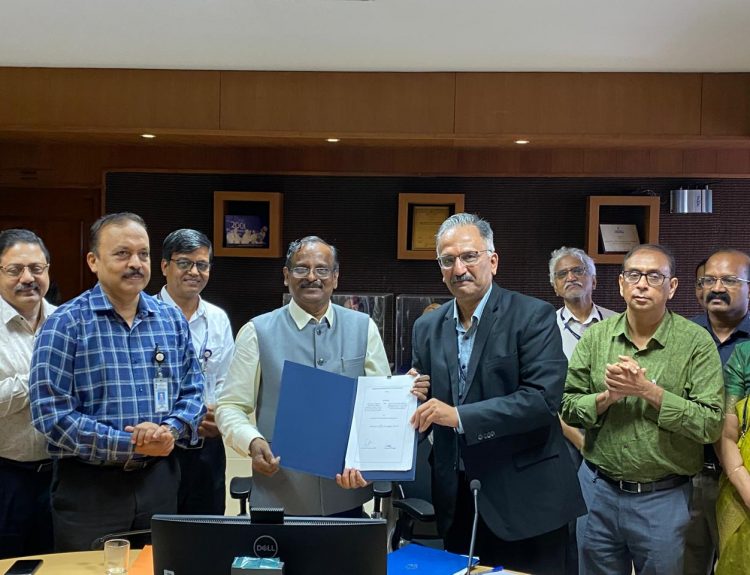
The two leaders welcomed the adoption of a Memorandum of Cooperation between Eindhoven University of Technology and University of Twente and six Indian leading Technical Institutes (IISc Bangalore, IIT Bombay, IIT Delhi, IIT Gandhinagar, IIT Guwahati and IIT Madras) for a brain bridge in semiconductors and related technologies, with industry partnership from NXP, ASML, TATA and CG Semi. This would catalyse the R&D and talent development with academia and industry participation from both sides.
Recognizing the strategic importance of critical minerals for continued innovation, and the need for global cooperation to build resilient and sustainable supply chains, the two leaders expressed their mutual interest in strengthening cooperation across the critical minerals value chain, including exploration, research and innovation, integration of value chains, supply chain resilience, circularity and ESG standards and related assessments. In this context, the leaders welcomed the signing of a Memorandum of Understanding on Critical Minerals.
The two leaders also welcomed the signing of a Memorandum of Understanding on Higher Education between the Ministry of Education of India and the Ministry of Education, Culture and Science of the Netherlands to promote cooperation between the higher education institutions of the two countries, in accordance with their respective academic and educational priorities and needs.
Both leaders also expressed satisfaction at the on-going institutional cooperation between Dutch and Indian universities including recent collaborations for example between: University of Groningen and Nalanda University; Delft University of Technology and Mumbai Metropolitan Regional Development Authority; Survey of India and ITC, University of Twente; Vrije Universiteit Amsterdam and Indian Institute of Technology Roorkee; and many more. Both leaders acknowledged that platforms like Indo-Dutch Education & Academic Network can play a significant part to further strengthen the educational and scientific collaboration.
Both leaders acknowledged the ongoing space partnership between India and the Netherlands and the possibility for intensifying the same, specifically on using space-based applications in addressing societal challenges including climate change, water issues, food security as well as air quality.