
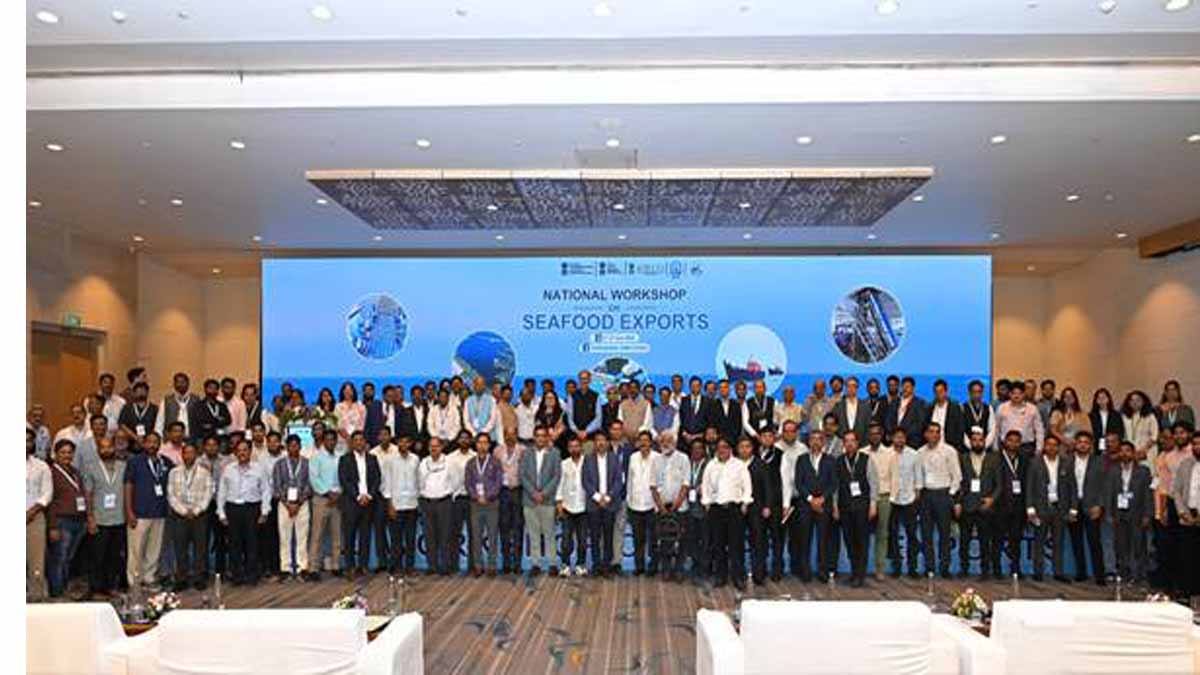

A National Workshop on Seafood Exports was convened by the Department of Fisheries, Ministry of Fisheries, Animal Husbandry and Dairying, in collaboration with the Ministry of Commerce and Industry, with support from the Government of Andhra Pradesh, on 5th & 6th June 2026 in Visakhapatnam, Andhra Pradesh. The first day of the workshop was graced by Shri Nara Chandrababu Naidu, Hon’ble Chief Minister, Andhra Pradesh; Shri Piyush Goyal, Hon’ble Minister of Commerce & Industry; Shri Rajiv Ranjan Singh, Hon’ble Minister of Fisheries, Animal Husbandry & Dairying and Panchayati Raj; Shri Kinjarapu Rammohan Naidu, Hon’ble Minister of Civil Aviation, GoI; and Shri Chirag Paswan, Hon’ble Minister of Food Processing Industries, GoI.
The workshop brought together senior officials from the Central Government, along with representatives from States and Union Territories. Key national institutions, including the Marine Products Export Development Authority (MPEDA), Export Inspection Council (EIC), National Fisheries Development Board (NFDB), NABARD, NCDC, NCEL, SFAC and Invest India, participated. The workshop also witnessed the presence of seafood exporters, industry associations, processors, start‑ups, and other value‑chain stakeholders, ensuring comprehensive representation of the seafood export ecosystem.
The deliberations emphasized positioning India as a globally competitive seafood exporting nation. Key areas included the transition from volume-based exports to value-added, high-quality products, along with the promotion of innovation, advanced technologies, and robust traceability systems to strengthen India’s global seafood brand. Discussions also highlighted the need to expand export infrastructure and logistics, including cold chain, air cargo, and quarantine facilities, to ensure efficient and compliant trade.
The importance of enhancing exports from inland fisheries, which contribute significantly to production, and leveraging untapped potential in emerging segments such as ready‑to‑eat products and high‑value species, was highlighted. Ministers emphasised sustainability, quality assurance, and regulatory compliance, along with strengthening processing capacity and value chains. A strong thrust was also laid on adopting a whole‑of‑government approach, improving multimodal logistics, and promoting investment, innovation, and private sector participation, to build a resilient and future‑ready seafood export ecosystem.
Shri Sagar Mehra, Joint Secretary, Department of Fisheries, emphasised scaling up production, strengthening traceability and certification frameworks, and harnessing untapped potential in deep-sea and EEZ resources through ongoing reforms and flagship schemes. Shri Ajay Bhadoo, Additional Secretary, Department of Commerce, outlined India’s export performance, evolving global market dynamics, and the role of FTAs, market diversification and enhanced competitiveness in expanding seafood exports. Shri D. Praveen, Joint Secretary, Ministry of Food Processing Industries, underscored the need to scale up processing and value addition, highlighting gaps vis-à-vis global benchmarks, and outlined key schemes supporting cold chain development, processing infrastructure and value chain integration to improve export value realisation.
Shri Swatantra Kumar Singh, Secretary, Department of Fisheries, Government of Madhya Pradesh, emphasised the export potential of inland fisheries, with focus on cage culture, reservoir-based aquaculture and diversification into high-value activities such as pearl culture to boost farmers’ incomes and production. Officials from Export Inspection Council, highlighted the importance of robust quality assurance systems and compliance with international regulatory requirements, including residue control, antimicrobial standards and digital traceability, alongside strengthening certification and inspection mechanisms to enhance market access. The Department for Promotion of Industry and Internal Trade (DPIIT), along with industry bodies such as the Seafood Exporters Association of India (SEAI), Indian Fishmeal & Fish oil Exporters Association (IFAFEA), and Indian Marine Ingredients Association (IMIA), shared stakeholder perspectives on market opportunities, competitiveness, sustainability and key challenges affecting seafood exports.
During the deliberations, stakeholders highlighted key challenges across the seafood export value chain, including disease management, rising input costs, limited access to quality seed and quarantine facilities, and gaps in logistics, cold chain and processing infrastructure. Concerns were also raised regarding stringent certification requirements, antibiotic compliance, traceability, and low export contribution from inland fisheries, along with the need to diversify into high‑value species and markets.
On 6th June 2026, the workshop featured two thematic technical sessions focusing on strategic interventions required to strengthen India’s seafood export ecosystem and support the national objective of achieving seafood exports exceeding ₹1 lakh crore. The sessions brought together policymakers, exporters, industry leaders, researchers, start-ups, MSMEs and other stakeholders to deliberate on issues relating to certification, traceability, value addition, sustainability and emerging export opportunities in the fisheries sector.
The first technical session, titled “Advancing Seafood Exports: Leveraging Value Addition, Certification and Traceability,” was chaired by Shri D. V. Swamy, Principal Secretary, Government of Odisha, with Shri P. Jawahar, Chairman, MPEDA, and Joint Secretary, Ministry of Food Processing Industries, serving as co-chairs. The session focused on strengthening India’s export competitiveness through three key thematic discussions: (i) Traceability Systems to Support Catch Certification for Export Markets, (ii) Sustainable Certification in Aquaculture and Capture Fisheries, and (iii) Exploring a Production Linked Incentive (PLI) Framework for the Seafood Sector.