
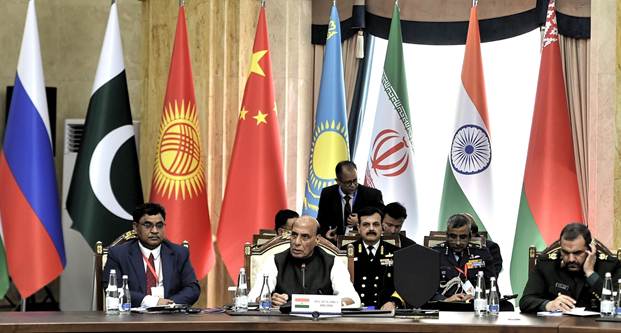

“Operation Sindoor demonstrated India’s firm resolve that terrorism epicentres are no longer immune to justifiable punishment,” said Raksha Mantri Shri Rajnath Singh as he addressed the Shanghai Cooperation Organisation (SCO) Defence Ministers’ Meeting in Bishkek, Kyrgyzstan on April 28, 2026, underlining the need to forge a unified front to tackle the “evils” of terrorism, separatism and extremism by eliminating safe havens and rejecting any political exceptions. He asserted that the sight of state-sponsored cross-border terrorism which attacks the sovereignty of a nation must not be lost as there is no place for double standards.
Raksha Mantri emphasised that SCO should not hesitate in seeking appropriate action against those who abet, shelter and provide safe havens to terrorists. “By tackling terrorism, separatism, and extremism without exception, we transform regional security from a challenge into a cornerstone for peace and prosperity,” he said.
Describing counter-terrorism as a foundational principle of SCO, Shri Rajnath Singh stated that the organisation has condemned such acts and ideologies in a common fight against the menace. He recalled last year’s Tianjin Declaration which brought out India’s firm & collective stance against terrorism, terming it as a testimony to the country’s zero-tolerance outlook towards terrorism and its perpetrators. “The real test of collective credibility remains in consistency. We must not forget that terrorism has no nationality and no theology. Nations must take a firm & collective stance against terrorism,” he added.
Raksha Mantri highlighted the significant role being played by the Regional Anti-Terrorist Structure of SCO, stating that the joint statement of the Heads of State on ‘Countering Radicalisation leading to Terrorism, Separatism and Extremism’ issued during India’s Chairmanship symbolises shared commitment in this regard. He further stated that, in view of the present global uncertainties, SCO holds a pivotal role as today’s world view appears fractured and countries are becoming increasingly inward-looking.
“Do we need a new world order or a world which is more orderly? We need an order where every citizen of this world is treated with dignity and respect. We need an order where differences do not become disputes and disputes don’t precede disasters. The real crisis today is not of a non-existent order but a tendency to question the established rule-based world order. We must focus on a global consensus where co-existence, co-habitation and compassion take precedence over chaos, competition and conflict,” said Raksha Mantri.
Shri Rajnath Singh added that it is the responsibility of SCO to ensure regional as well as global peace and stability. “We should continue to follow the path of dialogue and diplomacy and not of unrelenting force. We should not allow it to become an era of violence and war, but an era of peace and prosperity. Let me recall the message of Mahatma Gandhi that an eye for an eye makes everyone blind and before every action we must remember how that action can make a difference to the life of a poor and needy. As people responsible for defence and security, we have the responsibility to uphold this spirit of brotherhood and harmony. The real test of power is not in using it against the poor and the weak, but to use it in the interest of those who are unable to defend themselves,” he stated.
Raksha Mantri voiced India’s belief that SCO possesses the requisite strength and resolve to significantly contribute towards peace and stability. The ancient Indian philosophy of Vasudhaiva Kutumbakam embodies this sense of togetherness, overcoming all differences of race and religion, he said.
Shri Rajnath Singh reiterated India’s commitment to contribute constructively to the implementation of the SCO’s mandate, advocating that greater cooperation and mutual trust among member states based on equality, mutual respect and deeper understanding can make this organisation a beacon of hope and peace.
During the meeting, Raksha Mantri, along with member countries, held discussions on matters related to the aspects of security, terrorism and radicalisation affecting the region and its wider implications on the peace and tranquility of the world. The SCO members emphasised the symbolic significance of 2026, which marks the 25th anniversary of the founding of the organisation and how its role is becoming more important than ever due to growing unpredictability and uncertainty.