

The vegetable seller at a crowded market and the tea vendor outside a busy office are familiar sights in Indian cities. The fruit cart owner navigating lanes and the cobbler repairing shoes on a roadside pavement are equally essential to everyday urban life. Together, these millions of street vendors keep India’s urban economy moving every single day. They provide affordable goods and essential services while sustaining local markets and neighbourhood supply chains. However, they had limited access to formal credit, forcing many vendors to depend on informal credit at very high interest rates. Addressing their challenges, the Prime Minister Street Vendor’s AtmaNirbhar Nidhi (PM SVANidhi) scheme was launched in June 2020 as a first-of-its-kind micro-credit initiative focused on street vendors with government-backed credit guarantee support. The scheme sought to provide “Swarozgar, Svavlamban and Swabhimaan” to the street vendors. Today, PM SVANidhi has evolved far beyond a simple loan programme to a nationwide movement advancing financial empowerment, digital inclusion and social security for millions working in India’s informal economy.
Over the past years, the scheme has witnessed remarkable growth across cities and towns nationwide. More than 75.5 lakh beneficiaries have availed over 1.12 crore loans amounting to more than ₹17,800 crore. Over 55 lakh beneficiaries have been onboarded digitally under the scheme. Together, they have carried out over 841 crore digital transactions worth nearly ₹8.96 lakh crore. Beneficiaries under PM SVANidhi have also received nearly ₹800 crore through digital cashback incentives and interest subsidies. Building on the strong achievements and measurable impact, the scheme has been extended until March 2030.
Working Capital Loan: Collateral-free loans of ₹15,000, ₹25,000, and ₹50,000 are provided in three progressive tranches with interest subsidy and credit guarantee support.
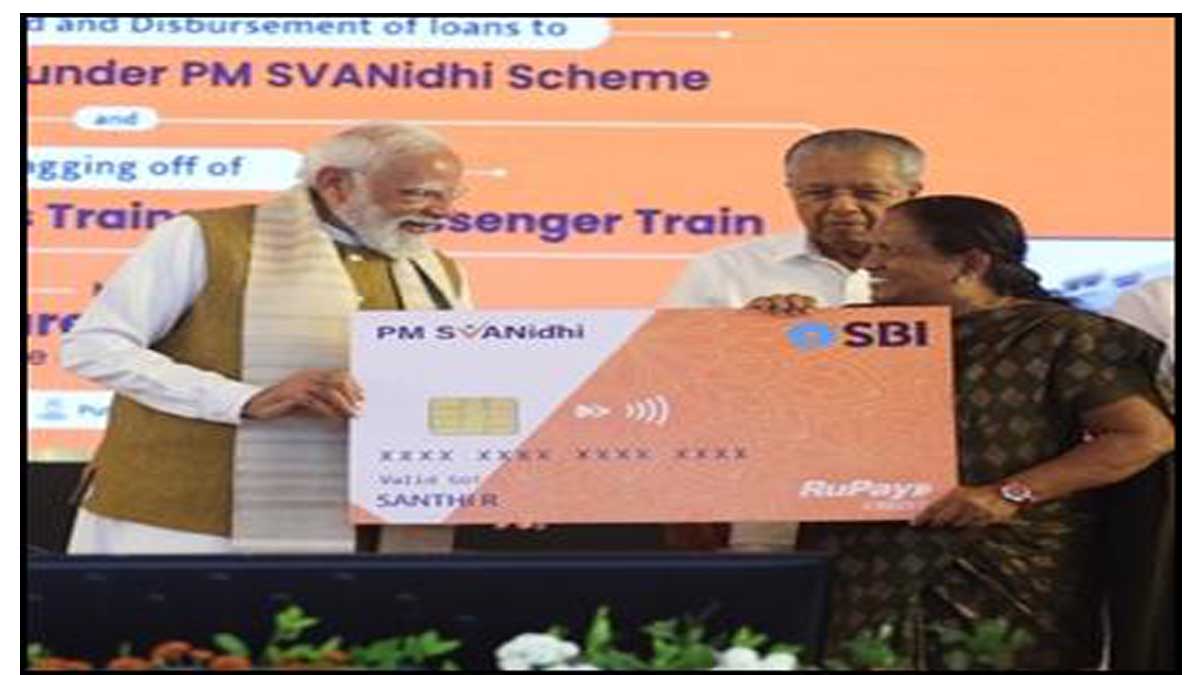
UPI-linked RuPay Credit Cards: Vendors successfully repaying the second tranche are eligible for UPI-linked RuPay Credit Cards with limits up to ₹30,000.
Digital Adoption: Cashback incentives of up to ₹1,600 are provided to street vendors for retail/wholesale digital transactions to encourage digital adoption and financial literacy.
SVANidhi se Samriddhi (SSS): Socio-economic profiling of beneficiaries and their families is undertaken to link them with eight selected Central welfare schemes and create a holistic social security net.
Capacity Building & Entrepreneurship Development: Vendors are provided with training in financial literacy, digital literacy, and food safety & hygiene in collaboration with FSSAI.
Impact of the PM SVANidhi Scheme
Independent impact assessments of PM SVANidhi were conducted in 2023 and 2025. The studies highlighted the following significant improvements:
Economic Empowerment
The scheme has strengthened business sustainability and improved earnings for vendors across the country. Nearly 95% of beneficiaries accessed formal institutional credit for the first time under PM SVANidhi. Around 30% later accessed additional credit beyond SVANidhi loans, reflecting improved creditworthiness and financial inclusion. Beneficiary incomes also recorded an average annual increase of nearly 20%.
Improvement in Household Welfare
The economic gains under PM SVANidhi contributed significantly to improving beneficiaries’ living standards. The scheme supported greater housing stability and improved access to nutritious food, healthcare and education.
PM SVANidhi has also strengthened social inclusion among vulnerable urban communities. Nearly 46% of beneficiaries under the scheme are women, reflecting strong gender inclusion. Around 70% belong to marginalised communities, highlighting the scheme’s inclusive outreach.
Voices of Resilience and Empowerment
Behind the numbers and loan disbursements are stories of perseverance, courage and renewed aspiration. For many vendors, PM SVANidhi has opened doors to stability, growth and opportunities once considered out of reach. These experiences from different parts of the country highlight how timely facilitation is helping small businesses recover, adapt and move forward with greater confidence.
From a small stall to a shop
Babita Sharma from Nandgram, Ghaziabad, runs a small shop selling puja items near a local temple. Every day, devotees visit her stall to buy incense sticks, diyas, flowers, coconuts, and other items needed for puja. While the business helped support her family, limited funds often made it difficult for her to expand and meet customer demand. In July 2020, Babita learned about the PM SVANidhi Scheme through officials of the Urban Local Body (ULB). Seeing it as an opportunity to improve her livelihood, she applied for the loan under the scheme. After receiving the first PM SVANidhi loan, Babita invested the money in purchasing additional stock and introducing more products at her stall. The wider variety attracted more customers and helped increase her daily sales and income. Encouraged by the improvement in her business, she repaid the loan on time and became eligible for the second tranche. She used this loan to purchase a cart and improve her vending setup.