


Affordable Crop Insurance for Every Farmer
Pradhan Mantri Fasal Bima Yojana (PMFBY) offers comprehensive coverage against droughts, floods, cyclones, hailstorms, pests, diseases, prevented sowing, localized calamities, damage by inundation, unseasonal rainfall, hailstorms and specified post-harvest losses nationwide. With ₹12,200 crore allocated for 2026–27, PMFBY continues strengthening farmer resilience, protecting livelihoods, stabilizing incomes, and supporting climate-resilient agriculture nationwide. In the last 10 years, since the inception of the scheme in Kharif 2016 till Rabi 2025-26, more than 92.46 crore farmer applications have been insured, and over 26.33 crore farmer applications have been paid claims exceeding ₹2.06 lakh crore. The integration of technology-driven initiatives such as the Yield Estimation System based on Technology (YES-TECH) and the Weather Information Network and Data System (WINDS) has further strengthened the scheme by enabling faster, fairer, and more transparent claim settlement.
Securing Rural Livelihoods Through Crop Insurance
Crop insurance protects farmers from crop losses caused by natural calamities, adverse weather, pests, and diseases. Timely compensation helps farmers manage income shocks, recover losses, repay loans, and invest in the next cropping season. It strengthens farm resilience, safeguards livelihoods, and supports continuity of agricultural production during uncertain conditions.
On 18 February 2016, the Pradhan Mantri Fasal Bima Yojana (PMFBY) was launched to bring the maximum number of farmers under crop insurance coverage. It covers risks from pre-sowing, including prevented or failed sowing, widespread mid-season adversity, localized calamities caused by hailstorms, inundation, landslide, etc., at individual land parcels, to post-harvest losses caused by cyclones, unseasonal rains, and other specified perils. Premium rates remain low and affordable to encourage wider farmer participation. The Government has allocated ₹12,200 crore for PMFBY in the Union Budget 2026–27, reinforcing its continued commitment to crop insurance and farmer coverage.
PMFBY in Action: A Farmer’s Story of Resilience
Anwar Hussain, a small farmer from Chankhala village in Assam’s Nagaon district, depends entirely on agriculture for his family’s livelihood. When heavy rains severely damaged his crop, he faced uncertainty over repaying his loans and financing the next sowing.
Fortunately, Anwar had enrolled under the Pradhan Mantri Fasal Bima Yojana (PMFBY) by paying a nominal premium of just Rs 100. After the crop loss was assessed, he received ₹50,600 in compensation under the scheme. This timely financial support helped him recover from the loss, repay part of his debt, and invest in inputs for the next season. With this support, Anwar was able to continue farming with renewed confidence instead of falling into financial distress. Today, he strongly encourages other farmers in his village to insure their crops, saying that PMFBY acts as a safety net during times of crisis.
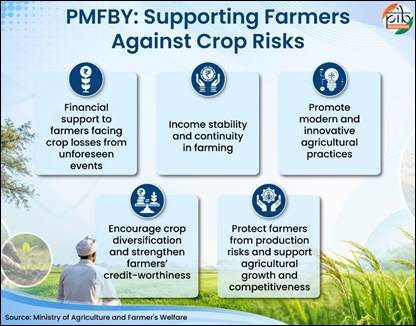
PMFBY provides financial coverage against crop losses and helps stabilise farmers’ incomes. It also promotes modern farming practices, crop diversification, and resilience against production risks.
Inclusive Coverage of Farmers
PMFBY provides inclusive crop insurance coverage to farmers, including tenant farmers and sharecroppers, subject to prescribed eligibility conditions. Farmers must have an insurable interest, valid land documents or tenure agreements or sowing certificates as per state-specific pre-defined requirements, and apply within the specified timeframe. To ensure inclusive risk coverage, PMFBY covers both loanee and non-loanee farmers across the agricultural range.
Non-loanee farmers are those without crop loans or with non-standard Kisan Credit Card (KCC)-linked loans. They can voluntarily enroll under PMFBY for crop insurance coverage. In the last 10 years, on average, 50% of all farmers have voluntarily enrolled as non-loanee farmers, establishing trust among farmers in the scheme.
Loanee farmers are those who take seasonal crop loans from banks or financial institutions, and their loans or KCCs are active and standard. Their premiums are automatically deducted from the loan amount by the respective banks.
PMFBY generally provides comprehensive risk cover for all natural and climatic calamities leading to damage or loss of crops, provided that the crop has been insured and the corresponding premium has been paid to the Insurance Company within predefined timelines. However, crop losses in non-notified areas, outside the covered crop lifecycle (i.e., before sowing and after removal of the crop from the field), and losses caused by negligence or man-made or preventable risks are not covered.
Risks Covered
PMFBY provides coverage against crop losses at different stages of cultivation and harvesting:
Yield Losses (standing crops, on notified area basis): PMFBY provides area-based coverage against non-preventable risks such as drought, dry spells, floods, inundation, cyclones, hailstorms, lightning, pests and diseases.
Prevented Sowing: Where insured farmers incur expenditure but are prevented from sowing due to adverse weather conditions, they shall be eligible for claims up to a maximum of 25% of the sum insured.
Post-Harvest Losses: Crops kept in “cut-and-spread” condition for drying in the field are covered for up to 14 days after harvesting against specified cyclonic and unseasonal rain events.
Localized Calamities: Individual farm-level losses caused by hailstorms, landslides, inundation, cloud bursts, and damage by natural fire are covered under specified conditions.
However, PMFBY excludes losses from war, nuclear risks, riots, theft, specified post-harvest conditions, and other preventable risks.
Progress and Achievements Under PMFBY
PMFBY has witnessed significant expansion in farmer participation, insurance coverage, and institutional reach in recent years. Farmers pay a maximum premium of 2% for Kharif and 1.5% for Rabi foodgrain and oilseed crops. For commercial and horticultural crops, the maximum premium is 5%. The Central & State Governments subsidizes the remaining premium in 50:50 proportion. For the farmers in North-Eastern & Himalayan States/UTs, the contribution of Central & State Govt. subsidy is in a 90:10 proportion. This affordable premium structure has helped make crop insurance accessible to a wider section of farmers across the length and breadth of the country.