
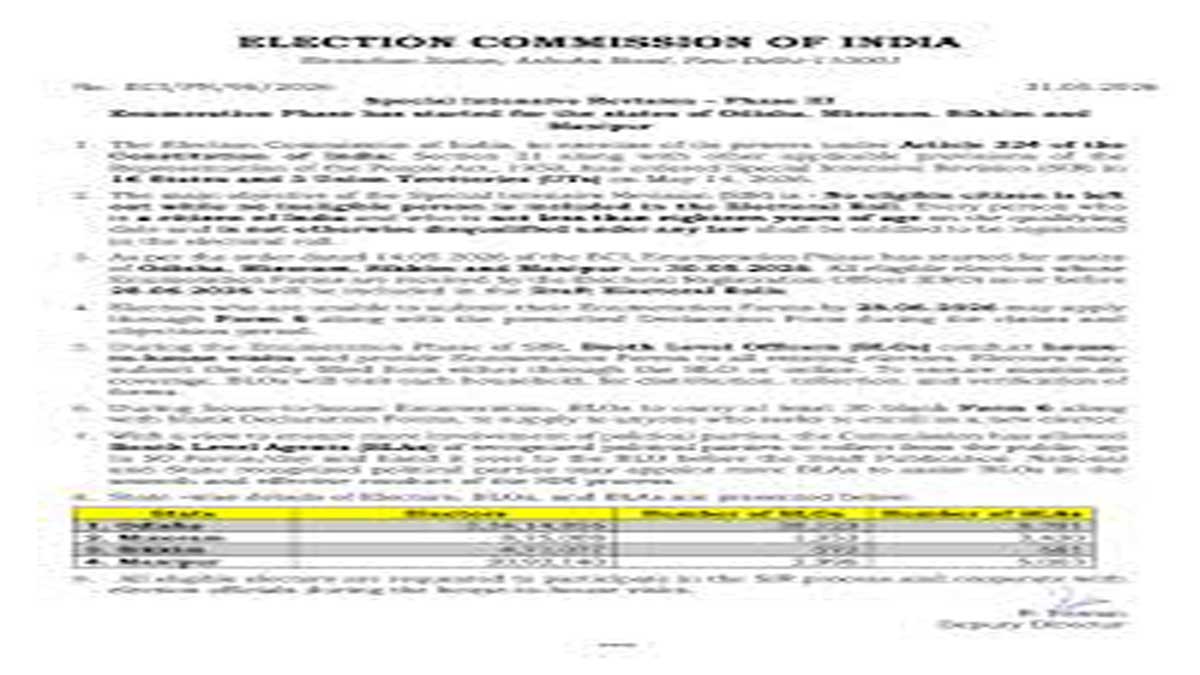

The Election Commission of India, in exercise of its powers under Article 324 of the Constitution of India; Section 21 along with other applicable provisions of the Representation of the People Act, 1950, has ordered Special Intensive Revision (SIR) in 16 States and 3 Union Territories (UTs) on May 14, 2026.
The main objective of the Special Intensive Revision (SIR) is – No eligible citizen is left out while no ineligible person is included in the Electoral Roll. Every person who is a citizen of India and who is not less than eighteen years of age on the qualifying date and is not otherwise disqualified under any law shall be entitled to be registered in the electoral roll.
As per the order dated 14.05.2026 of the ECI, Enumeration Phase has started for states of Odisha, Mizoram, Sikkim and Manipur on 30.05.2026. All eligible electors whose Enumeration Forms are received by the Electoral Registration Officer (ERO) on or before 28.06.2026 will be included in the Draft Electoral Rolls.
Electors who are unable to submit their Enumeration Forms by 28.06.2026 may apply through Form 6 along with the prescribed Declaration Form during the claims and objections period.
During the Enumeration Phase of SIR, Booth Level Officers (BLOs) conduct house-to-house visits and provide Enumeration Forms to all existing electors. Electors may submit the duly filled form either through the BLO or online. To ensure maximum coverage, BLOs will visit each household, for distribution, collection, and verification of forms.
During house-to-house Enumeration, BLOs to carry at least 30 blank Form 6 along with blank Declaration Forms, to supply to anyone who seeks to enroll as a new elector.
With a view to ensure more involvement of political parties, the Commission has allowed Booth Level Agents (BLAs) of recognized political parties to collect from the public, up to 50 Forms/day and hand it over to the BLO before the Draft Publication. National and State recognized political parties may appoint more BLAs to assist BLOs in the smooth and effective conduct of the SIR process.