

The Bureau of Indian Standards (BIS) has published a number of standards for medical assistive technologies as a part of the NLEAP (National List of Essential Assistive Products) initiative brought about by Indian Council of Medical Research (ICMR). The NLEAP document aims to serve as a guideline for policymakers, healthcare providers, and the concerned stakeholders for provision of assistive products as well as support the development of assistive technologies across the country.
The BIS Technical Committee on Assistive Products including Rehabilitation Appliances, Orthotic and Prosthetic Items (MHD 09) formulates Indian Standards pertaining to assistive technologies. The scope of committee is to formulate Indian Standards for Assistive Products including Rehabilitation Appliances, Orthotic and Prosthetic Items involved in assistance or rehabilitation of persons with disabilities, elderly persons and persons with impairments due to non-communicable diseases. This national committee formulates standards through the consensus of various relevant stakeholders including technical experts from the Indian industry, academia and government bodies such as ALIMCO Kanpur (Artificial Limbs Manufacturing Corporation of India), ICMR and Pandit Deendayal Upadhyaya National Institute for Persons with Physical Disabilities under the chairmanship of Dr. Sanjay Wadhwa, Head (Physical Medicine & Rehabilitation), AIIMS New Delhi. Social organizations like BMVSS Jaipur (Bhagwan Mahaveer Viklang Sahayata Samiti) are also a part of the committee for representation of consumer interests. The national committee also participates in the international technical committees of ISO: ‘Assistive Products’ (ISO/TC 173) and ‘Prosthetics and Orthotics’ (ISO/TC 168) for harmonization with the global standards.
BIS has published the following standards in the past year for mobility aids, structural aids and accessible designs which are listed as priority assistive products under the NLEAP:
IS 18558 (Part 1): 2025/ISO 11334-1 Elbow crutches
The Standard specifies requirements and test methods for elbow crutches fully equipped with handgrip and tip including requirements relating to safety, ergonomics, performance, and information to be supplied by the manufacturer, including marking and labelling.
IS 5145: 2026 Walking sticks
IS 5145 covers the requirements pertaining to material, shape, dimensions, workmanship, finish and performance of walking sticks (including wooden, cane, aluminium, plastic and rubber). This is an indigenous standard developed after consultation with the technical experts from the Indian industry.
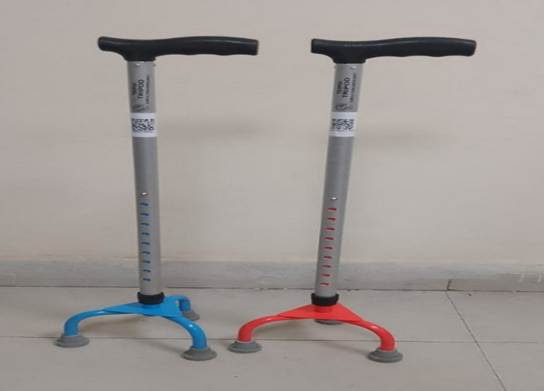
IS 18558 (Part 4): 2025/ISO 11334-4 Walking sticks, three or more legs
IS 18558 (Part 4) specifies requirements and methods of walking sticks with three or more legs and fully equipped with handle and tips. It also gives the requirements relating to safety, ergonomics, performance, marking and labelling.
IS 19189: 2025/ISO 19028 Accessible Design — Information Contents, Figuration and Display Methods of Tactile Guide Maps
The Standard explains what information tactile guide maps should include and how they should be designed and displayed. These maps help people who are blind or have low vision understand buildings (like public places, transport areas, and parks) and nearby routes, so they can move around safely and easily.
IS 19190: 2025/ISO 17049 Accessible Design —Application of Braille on Signage Equipment and Appliances
The Standard specifies the fundamental requirements for braille used on signage, equipment and appliances, including the dimensional parameters of braille and the characteristics of materials used, and the guidelines for practical implementation.