
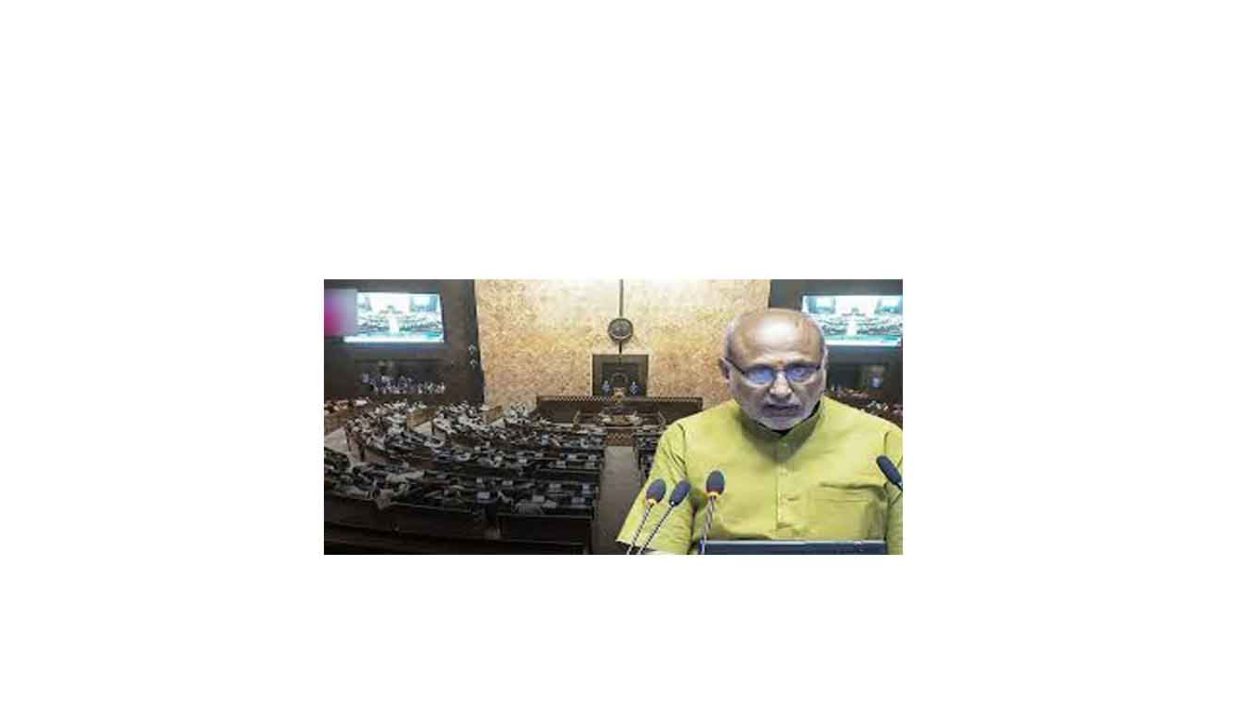

CHAIRMAN: Hon’ble Members, I would like to inform this August House of a significant milestone in India’s journey of scientific progress and technological self-reliance.
On 6 April 2026, at Kalpakkam in Tamil Nadu, India achieved an important scientific breakthrough. Our 500-Megawatt Prototype Fast Breeder Reactor, PFBR, has successfully attained first criticality. This marks the moment when a controlled and sustained nuclear chain reaction has been initiated in the reactor.
Hon’ble Members, this is not merely a technological milestone. It is a moment of national achievement. Over two decades in the making, it marks the successful culmination of sustained efforts by thousands of our scientists, engineers, industries and multiple units of the Department of Atomic Energy.
This historic achievement bolsters the Nuclear Energy Mission and strengthens India’s global commitment of achieving net-zero emissions by 2070, as announced by the Hon’ble Prime Minister Shri Narendra Modi ji. The core-loading of PFBR was also witnessed by the Hon’ble Prime Minister in March 2024.
India’s nuclear strategy is envisioned in three stages to optimise the use of our limited Uranium resources and abundant Thorium reserves. The first stage currently in operation uses natural Uranium in Pressurised Heavy Water Reactors, producing Plutonium as a by-product. With the realisation of PFBR, India has taken an historic step of advancing to the second stage. In this stage, we will utilise Plutonium in Fast Breeder Reactors to generate more nuclear fuel. Unlike conventional reactors, a Fast Breeder Reactor has the unique capability to produce more fuel than it consumes. The third stage will be Thorium-Uranium based reactors, enabling a sustainable, long-term energy future.
At a time when India’s energy needs are steadily rising, and our commitment to clean energy is stronger than ever, nuclear power offers a reliable, round-the-clock, low-carbon source of electricity. The house had passed Sustainable Harnessing and Advancement of Nuclear Energy for Transforming India (SHANTI) Act in December 2025 to open up the civil nuclear energy sector to all players. With the whole-of-the-nation approach, we are steadily marching towards achieving the target of 100 Giga Watts of nuclear power.
With PFBR attaining criticality, India has entered the second stage of our long-envisioned programme in civil nuclear energy. The PFBR stands as a proud testament to India’s long journey of perseverance, innovation, and national commitment. It serves as a vital bridge, linking our present capabilities with a more sustainable and Atma Nirbhar nuclear future.
This achievement has been made possible entirely through indigenous effort. The reactor has been designed by the Indira Gandhi Centre for Atomic Research (IGCAR) and constructed by Bharatiya Nabhikiya Vidyut Nigam Limited (BHAVINI, with strong participation from Indian industry. It stands as a proud reflection of the strength of our scientific ecosystem and the power of national collaboration.
Hon’ble Members, with this milestone, India takes its rightful place among a select group of nations that have mastered this advanced technology. It reaffirms our standing as a nation capable of developing and deploying complex, frontier technologies with confidence and self-reliance.
More importantly, it reflects the confidence of a nation that believes in its own capabilities, and is determined to build a future that is secure, sustainable, and self-reliant.
Looking ahead, the successful operation of PFBR will support the expansion of nuclear power in the country and help us move faster towards the third stage of our programme. It will also open new opportunities in advanced reactor technologies, fuel cycle systems, and high-end engineering.
Hon’ble Members, this achievement marks a new beginning.
A beginning that carries forward the vision of our pioneers in science.
A beginning that strengthens our journey towards energy independence.
And a beginning that brings us closer to the goal of a Viksit Bharat.
It is also a moment that reaffirms our belief in the power of science and technology to shape our collective future and realise our shared aspirations.
From the first spark of a controlled chain reaction in PFBR emerges not only energy, but also the promise of a brighter future for generations to come.
I take this opportunity to place on record the appreciation of this House for the scientists, engineers, technicians, industry partners, and all stakeholders whose dedication and hard work have made this achievement possible.
Thank you.