
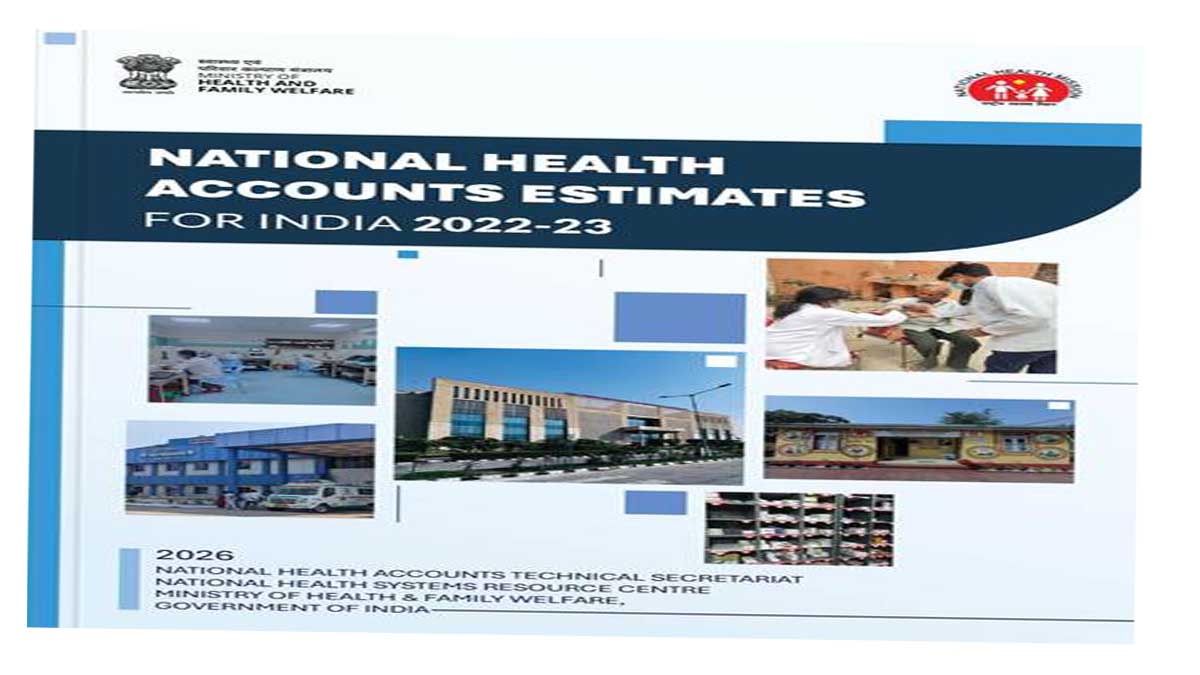

The Union Health Ministry released the National Health Accounts (NHA) estimates for India 2022-23. The NHA 2022–23 is the tenth report on health expenditure estimates prepared by the National Health Accounts Technical Secretariat (NHATS), National Health Systems Resource Centre, Ministry of Health and Family Welfare, using the System of Health Accounts (2011) framework. The report indicates an increase government expenditure on healthcare since 2013-14, reflecting sustained efforts to strengthen public investment in the health sector.
The share of Government Health Expenditure (GHE) in the country’s Gross Domestic Product (GDP) has risen from 1.15% in 2013–14 to 1.43% in 2022–23. As per the new GDP series with base year 2022-23, GHE as % of GDP is 1.48%. Similarly, GHE’s share in General Government Expenditure (GGE) has increased from 3.78% to 4.89% over the same period, underscoring the growing prioritisation of health in public spending. In per capita terms, GHE has increased nearly 2.7 times, from Rs. 1,042 to Rs. 2,786 between 2013-14 and 2022-23.
The decadal trend of increased Government Health Expenditure (GHE) has resulted in overall reduction in the Out-of-Pocket Expenditure (OOPE) as a share of the Total Health Expenditure (THE). The efforts of the Union Government, specifically during the COVID pandemic, were noteworthy. To address the emergency COVID pandemic situation, Government increased the health expenditure significantly to 1.84% of GDP in 2021-22 towards managing the pandemic situation which included ECRP-I & II, and mass COVID vaccination programme, that was largest in the world. Given these additional spending by the government as a one-time measure, OOPE as percentage of Total Health Expenditure (THE) during this period also declined to 39.4%.
The share of GHE in THE has increased by almost 15 percentage points, from 28.6% in 2013-14 to 43.7% in 2022–23. This shift underscores the important role of public financing in the health system and signals that policy efforts are moving in the right direction—towards a more affordable, equitable, and accessible healthcare system for all.
Reducing the burden of OOPE on households has been a key priority for the Government, pursued through various health schemes and a sustained commitment to Universal Health Coverage (UHC). Between 2013-14 and 2022–23, the share of OOPE in THE declined significantly by nearly 21 percentage points, from 64.2% to 43.4%.
Intertemporal comparisons also reveal a positive trend in the growth of Social Security Expenditure (SSE) on healthcare reflecting the government’s commitment to financial risk protection and reducing health inequities, the share of SSE in THE—which includes government-funded health insurance such as the AB PM-JAY, medical reimbursements to government employees, and social health insurance programmes—has increased substantially from 6% in 2013-14 to 9.9% in 2022–23. The share of Private Health Insurance in THE has also increased, from 3.4% to 9.2%, clearly indicating improved health-seeking behaviour due to awareness, and the population’s purchasing power.
The NHA Estimates 2022–23 released today can be accessed here: https://nhsrcindia.org/national-health-accounts-records
Background: Preparation of National Health Accounts (NHA) estimates was institutionalised at National Health Systems Resource Centre (NHSRC) in 2014 and NHSRC was designated as National Health Accounts Technical Secretariat.
As of now, 9 NHA estimates (2013-14 to 2021-22) have been prepared.
Methodology followed: System of Health Accounts, 2011 (SHA 2011).
Expert group for NHA comprise of experts from Ministry of Statistics and Programme Implementation (MOSPI), NITI Aayog, Ministry of Jal Shakti, Research Institutions- National Institute of Public Finance and Policy (NIPFP), National Council of Applied Economic Research (NCAER), and Institute of Economic Growth (IEG), and National Health Authority.