

The Telecommunications Act was passed by Parliament in 2023. It is a pathbreaking piece of legislation that replaced the archaic Telegraph Act of 1885.
The Telecommunications Act is a comprehensive piece of legislation that encompasses a wide range of services. Its implementation is carried out by different departments, depending on the nature of the service covered. The Ministry of Information and Broadcasting administers the provisions relating to television, radio, and associated services.
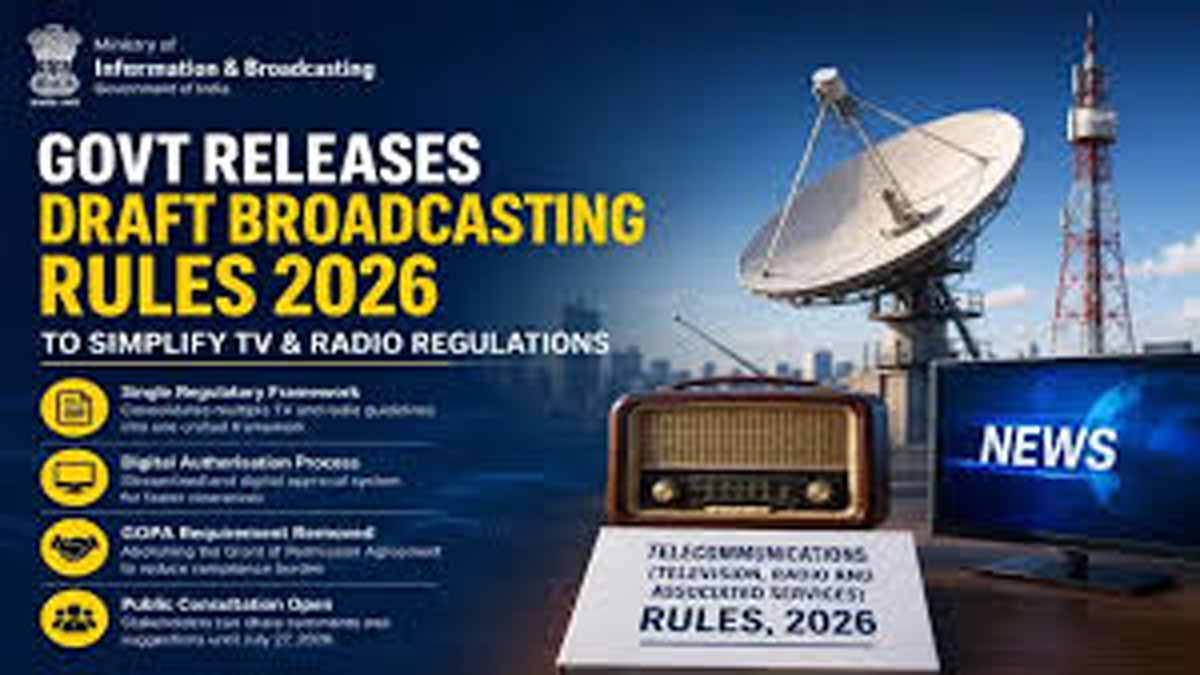
The draft Telecommunications (Television, Radio and Associated Services) Rules, 2026 have been framed to consolidate the various guidelines issued for television and radio services under the erstwhile Telegraph Act, 1885 within the framework of the newly enacted Telecommunications Act, 2023.
Following guidelines are integrated into this set of rules:
Policy Guidelines for Uplinking and Downlinking of Satellite Television Channels in India, dated 9th November 2022;
Guidelines for obtaining a license to provide Direct-to-Home (DTH) Broadcasting Services in India, dated 15th March 2001, as amended from time to time;
Guidelines for providing Headend-in-the-Sky (HITS) Broadcasting Services in India, dated 26th November 2009;
Policy Guidelines on Expansion of FM Radio Broadcasting Services through Private Agencies (Phase III), dated 25th July 2011, as amended up to 10th September 2024;
Revised Policy Guidelines for setting up Community Radio Stations in India, dated 13th February 2024; and
Guidelines for provisioning of Internet Protocol Television (IPTV) Services, dated the 8th September 2008.
With this set of rules, the industry will now have a unified and significantly simplified rule book. These rules are designed to simplify and harmonize the existing regime while promoting ease of doing business in the television and radio broadcasting sector.
Once notified, the rules will replace various existing guidelines governing broadcasting services. Key features of the Draft Rules include:
Change with Continuity: Existing terms and conditions of authorisation have been harmonised and rationalised to facilitate continuity while enabling reforms.
Ease of Doing Business
A single regulatory framework in place of multiple guidelines
Digital implementation of the authorisation process
Simplified authorisation procedures
Removal of the requirement for signing Grant of Permission Agreement (GOPA)
Provision of transparent adjudication mechanism
These draft rules have been published on the website of the Ministry of Information and Broadcasting (www.mib.gov.in) for public and inter-ministerial consultation.
Inputs, comments, or suggestions, if any, may be sent to the Under Secretary (BP&L), Ministry of Information and Broadcasting, Government of India, 3rd Floor, Kartavya Bhawan-II, New Delhi – 110001, preferably by email at usbpl-moib[at]gov[dot]in, by the 27th July, 2026.