
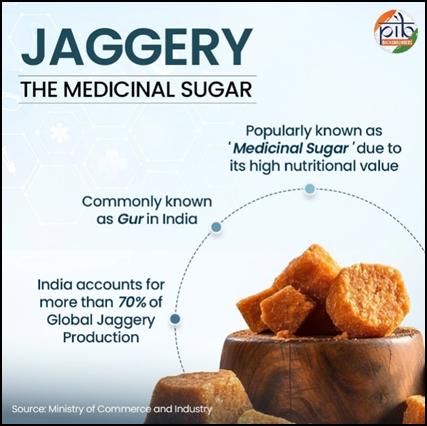

Jaggery, commonly known as gur, is a traditional, unrefined, natural sweetener. It is produced by concentrating sugarcane juice without the use of chemicals. Often called “medicinal sugar”, it is nutritionally comparable to honey. Jaggery is widely consumed across Asia, Africa, Latin America, and the Caribbean under various local names. It is valued for its natural origin, traditional processing methods, and growing consumer preference for chemical-free sweeteners.
India accounts for over 70 percent of global jaggery production. This makes it the world’s largest jaggery producer. Nearly 20–30 percent of the country’s sugarcane production is used for jaggery production. It is one of the major agro-processing industries in rural India.
The sector is marked by decentralized processing, low transport costs, small-scale entrepreneurship and cottage industries. It supports approximately 2.5 million livelihoods.India’s jaggery sector is supported by substantial sugarcane production. In 2024-25, total sugarcane output was estimated at 444.9 million tonnes (MT). Uttar Pradesh contributed 48.5 percent of total production, followed by Maharashtra (24.1 percent) and Karnataka (10.5 percent). Other producing states include Gujarat, Tamil Nadu, Bihar, Uttarakhand, Punjab, Madhya Pradesh, and Haryana